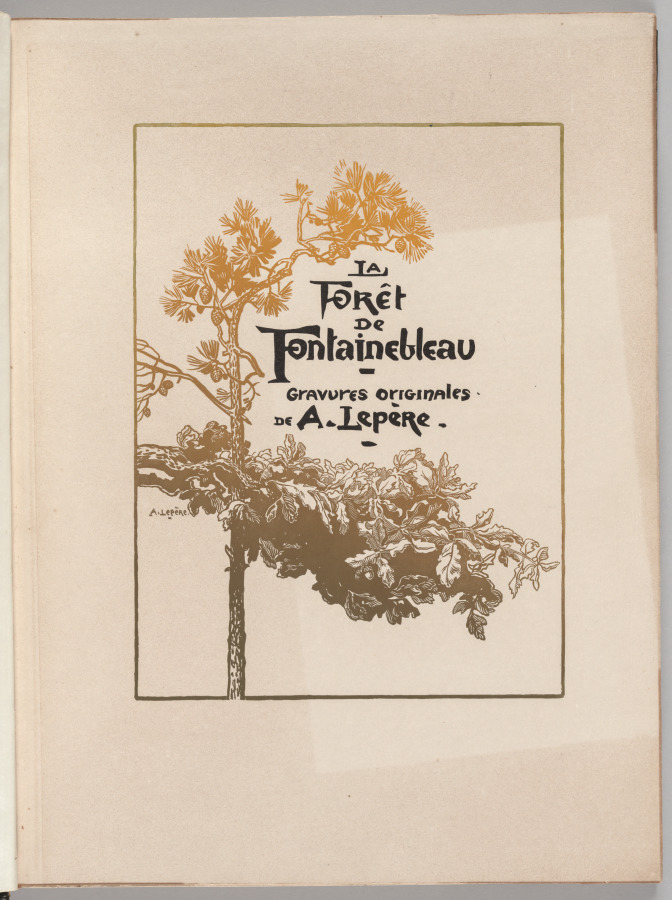
Fontainebleau Forest: Cover (La Forêt de Fontainebleau)
✦ Read about this
Auguste Louis Lepère (1849–1918) was among the central figures in the late nineteenth-century revival of original wood engraving in France, a medium then largely relegated to commercial reproduction. This sheet, made in 1890, is the cover for a bound volume of 34 engravings devoted to the Forest of Fontainebleau, published in the *Revue Illustrée* between 1887 and 1890 with A. Desmoulins.
The work is a wood engraving, with an image measuring roughly 29 by 22 cm on a larger sheet. Fontainebleau, the forest southeast of Paris long associated with the painters of the Barbizon school, was a frequent subject for artists working directly from the landscape.
The volume entered the Cleveland Museum of Art in 2014 as a gift from Carole W. and Charles B. Rosenblatt.
Background drawn from Cleveland Museum of Art
Today's poem
Heaven--Haven: A Nun Takes the Veil
I have desired to go Where springs not fail, To fields where flies no sharp and sided hail And a few lilies blow. And I have asked to be Where no storms come, Where the green swell is in the havens dumb, And out of the swing of the sea.
Gerard Manley Hopkins · Public domain
✦ Read about this
Gerard Manley Hopkins was an English poet and Jesuit priest. His religious vocation shaped much of his verse, and this early poem turns directly on monastic life: its subtitle, "A Nun Takes the Veil," frames the speaker as a woman renouncing the world for the cloister.
The poem is brief and tightly made, two four-line stanzas built on short lines and firm rhyme. It works through a series of landscapes of refuge—fields without hail, havens beyond storms, a place "out of the swing of the sea"—each defined by what it excludes rather than what it contains.
Its subject is the desire for shelter and stillness. The nun's longing is expressed as a wish to escape violence and change, to reach a settled place where nothing disturbs, drawing on natural imagery of springs, lilies, and quiet water to figure the peace she seeks in the religious life.
Background drawn from PoetryDB & Wikipedia