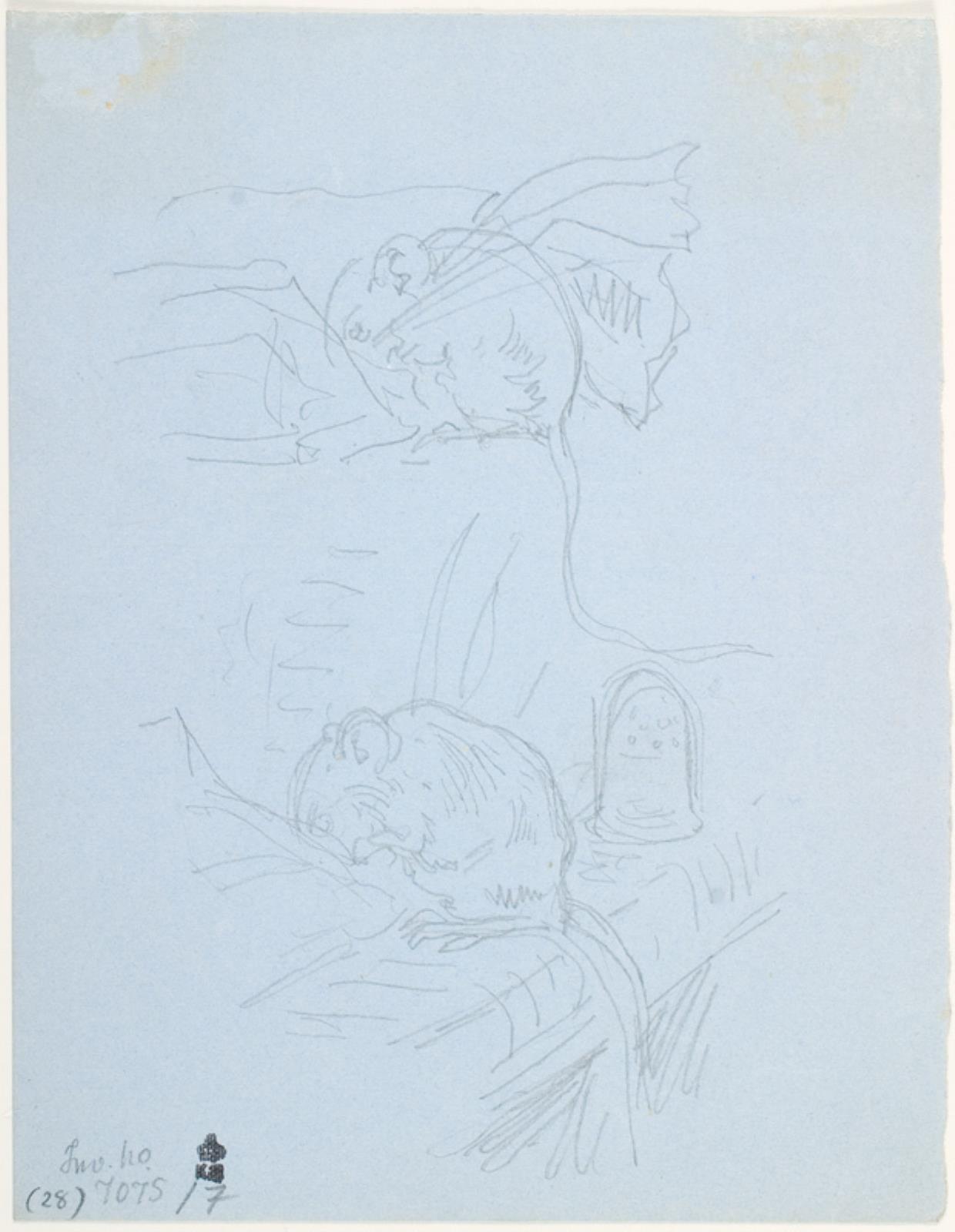
Studier af mus
✦ Read about this
These are working studies of mice, drawn in 1866 by Lorenz Frølich on blue paper, using pencil and pen with black ink. The combination of media—graphite underdrawing reinforced with ink—and the choice of a toned blue ground were common in nineteenth-century draughtsmanship, allowing the artist to build up detail and test the forms of a small, mobile subject.
Frølich (Danish) worked across painting, illustration, graphic art and etching. Studies of animals like these served as source material for his illustrative and printed work, where closely observed forms could be adapted to larger compositions.
The sheet is held by the SMK, the National Gallery of Denmark.
Background drawn from SMK — National Gallery of Denmark & Wikipedia
Today's poem
The murmur of a bee
The murmur of a bee A witchcraft yieldeth me. If any ask me why, 'T were easier to die Than tell. The red upon the hill Taketh away my will; If anybody sneer, Take care, for God is here, That's all. The breaking of the day Addeth to my degree; If any ask me how, Artist, who drew me so, Must tell!
Emily Dickinson · Public domain
✦ Read about this
Emily Dickinson wrote prolifically but published almost nothing during her lifetime; her work was largely unknown until after her death and is now regarded as canonical. The Poetry Foundation credits her with creating "a distinctively elliptical language for expressing what was possible but not yet realized."
"The murmur of a bee" exemplifies that compression. Across three short stanzas the poem registers the speaker's response to ordinary natural phenomena—a bee's hum, red light on a hill, the break of day—each of which overwhelms her beyond explanation. Each stanza follows the same pattern: a sensory experience, then the impossibility of accounting for it, closing on a terse refusal ("T were easier to die / Than tell") or deferral.
The poem locates the source of these effects outside the self, finally pointing to a divine maker—"Artist, who drew me so"—as the only one who could explain the speaker's susceptibility. Wonder here resists analysis, and the inability to articulate it becomes the poem's subject.
Background drawn from PoetryDB & Wikipedia