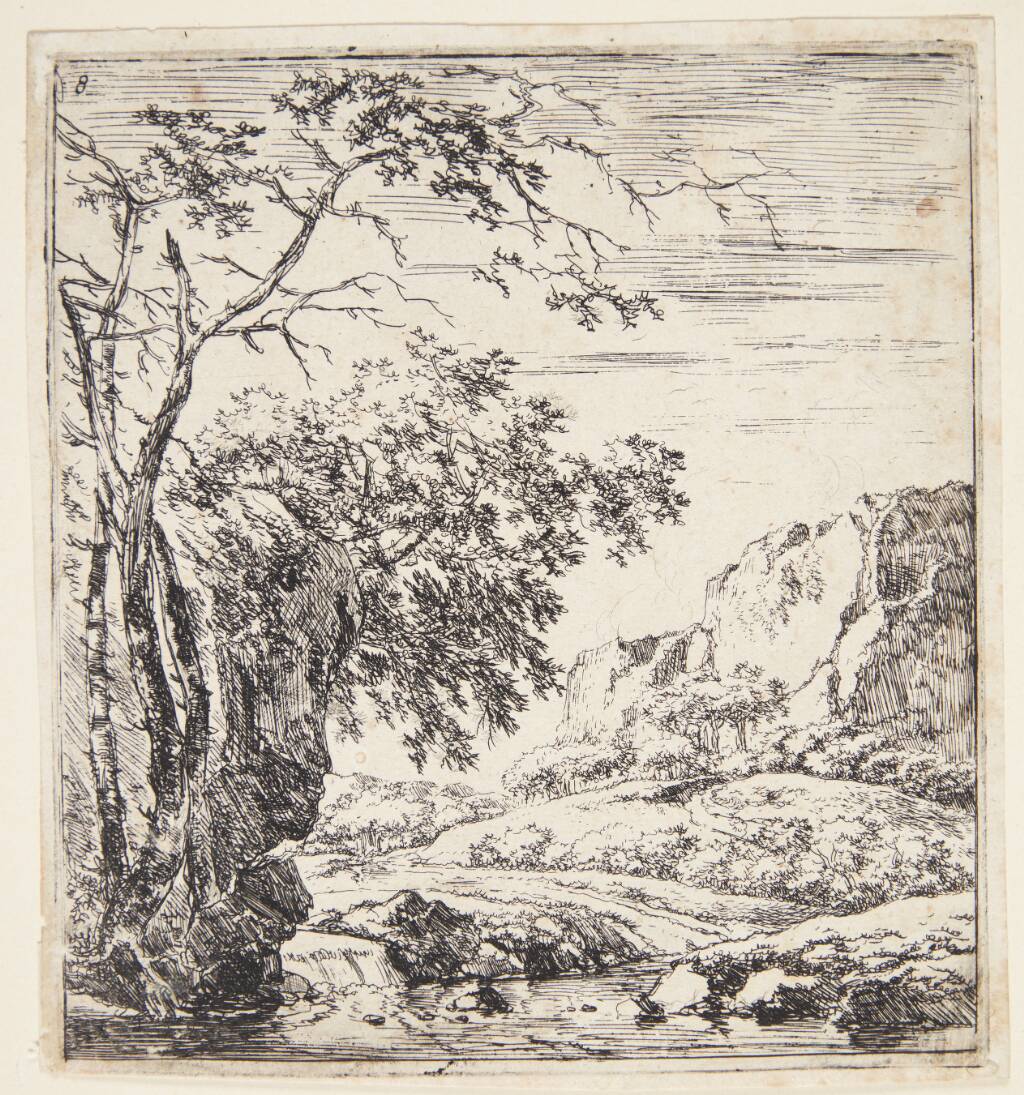
Træer ved foden af en klippe
✦ Read about this
Herman Naiwincx worked as a landscape painter and printmaker during the Dutch Golden Age, active in the mid-seventeenth century (his known dates span 1623–1670). Like many Dutch artists of his generation, he specialized in landscape, a genre that gained independent status in the Netherlands during this period.
*Træer ved foden af en klippe* ("Trees at the Foot of a Cliff") is an etching, a printmaking technique in which lines are bitten into a metal plate with acid before inking and printing. The work is held by the SMK, the National Gallery of Denmark.
Background drawn from SMK — National Gallery of Denmark & Wikipedia
Today's poem
Pied Beauty
Glory be to God for dappled things— For skies of couple-colour as a brinded cow; For rose-moles all in stipple upon trout that swim; Fresh-firecoal chestnut-falls; finches' wings; Landscape plotted and pieced—fold, fallow, and plough; And áll trádes, their gear and tackle and trim. All things counter, original, spare, strange; Whatever is fickle, freckled (who knows how?) With swift, slow; sweet, sour; adazzle, dim; He fathers-forth whose beauty is past change: Praise him.
Gerard Manley Hopkins · Public domain
✦ Read about this
Gerard Manley Hopkins was an English poet and Jesuit priest. His work was little known in his lifetime and is now valued partly for its metrical experiments, which strain and compress ordinary syntax into dense, musical lines.
"Pied Beauty" is a short poem of praise, cataloguing things that are mottled, mixed, or irregular: skies "couple-colour as a brinded cow," the "rose-moles" on trout, fallen chestnuts, the patchwork of farmed land, and the "gear and tackle" of trades. From these particular, dappled examples the poem moves to a general celebration of whatever is "counter, original, spare, strange," crediting all such variety to God, "whose beauty is past change."
The poem is a compressed sonnet-like form, sometimes called a curtal sonnet, ending on the two-word line "Praise him." Its texture depends on heavy alliteration, paired opposites ("swift, slow; sweet, sour"), and coinages that mimic the varied, irregular beauty it describes.
Background drawn from PoetryDB & Wikipedia