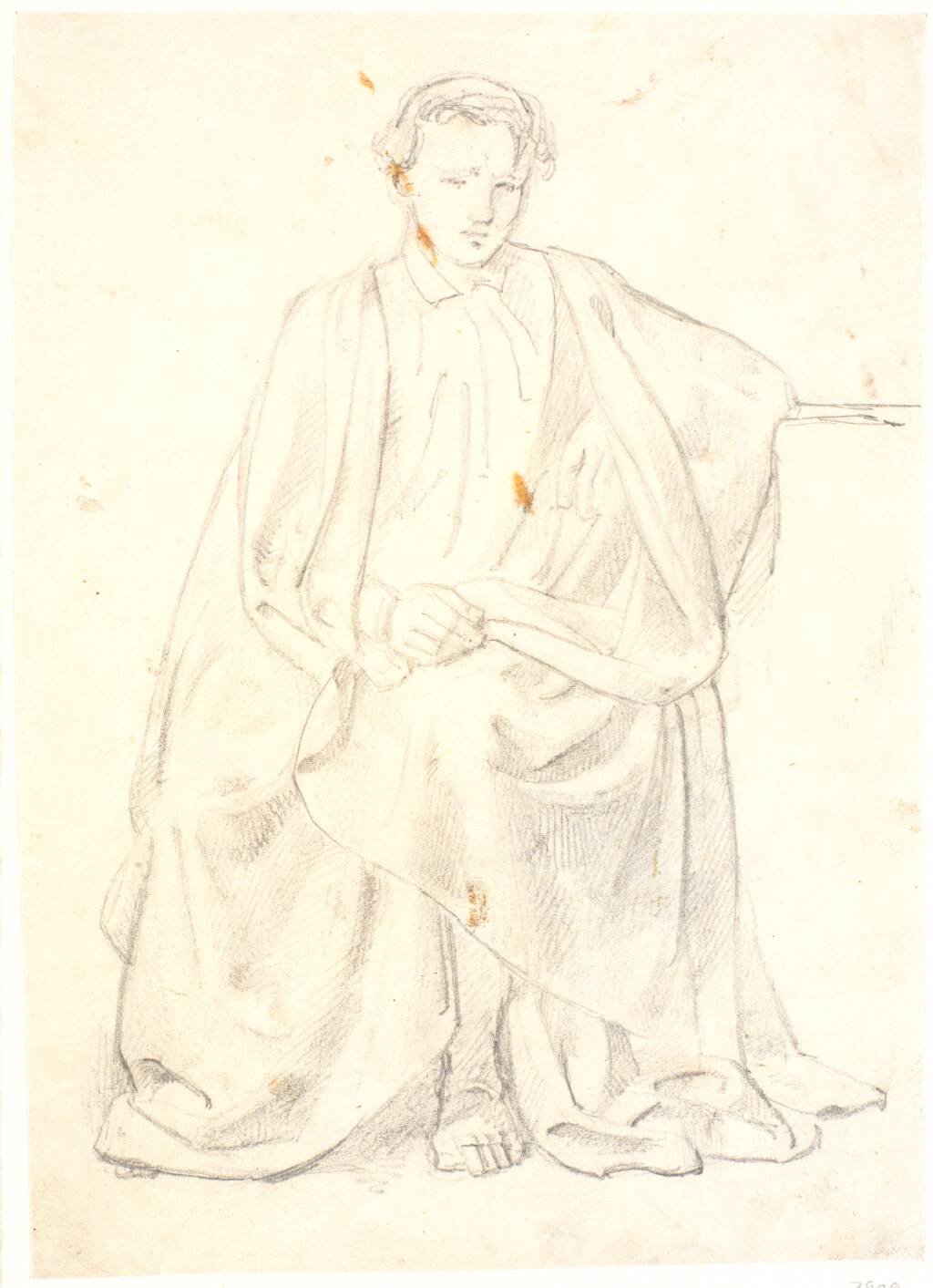
Studie af en model (en kunstnerkammerat?) i en lang kappe
✦ Read about this
Though Dankvart Dreyer is best known as a landscape painter, this is a pencil figure study—likely of a model, possibly a fellow artist, draped in a long cloak. Such drawings reflect the academic training Dreyer received under Christoffer Wilhelm Eckersberg, where close observation of the figure was fundamental.
Dreyer belonged to the Copenhagen School and, around 1840, worked within the emerging National Romantic landscape tradition in Denmark. His dramatic and emphatically naturalistic style, however, ran against the aesthetic and ideological expectations of the period. Widely criticized, he withdrew from the artistic establishment and fell into near obscurity.
The drawing is dated to the span 1831–1852, the latter year marking Dreyer's death from typhus at the age of 36. It is held by the SMK — National Gallery of Denmark.
Background drawn from SMK — National Gallery of Denmark & Wikipedia
Today's poem
Spring Quiet
Gone were but the Winter, Come were but the Spring, I would go to a covert Where the birds sing; Where in the whitethorn Singeth a thrush, And a robin sings In the holly-bush. Full of fresh scents Are the budding boughs Arching high over A cool green house: Full of sweet scents, And whispering air Which sayeth softly: "We spread no snare; "Here dwell in safety, Here dwell alone, With a clear stream And a mossy stone. "Here the sun shineth Most shadily; Here is heard an echo Of the far sea, Though far off it be."
Christina Rossetti · Public domain
✦ Read about this
Christina Rossetti (1830–?) was an English poet known for both romantic and devotional verse, including the long narrative "Goblin Market" and the sonnet "Remember." She was among the notable English poets of the nineteenth century.
"Spring Quiet" imagines a retreat from winter into a sheltered green covert where birds sing. The poem builds its scene through short lines and simple rhymes, moving from the thrush and robin in the whitethorn and holly to the budding boughs, fresh scents, and a cool, shaded enclosure.
In its closing stanzas the poem gives voice to the "whispering air," which promises safety and solitude beside a clear stream and a mossy stone. The final image—an echo of the far sea heard even in this secluded spot—links the enclosed refuge to a wider world beyond it.
Background drawn from PoetryDB & Wikipedia