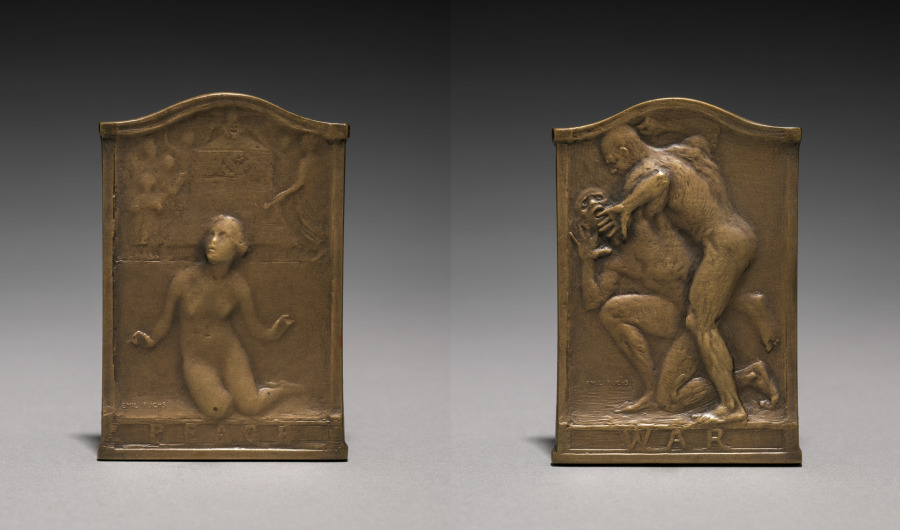
Medal: Commemorates the Signing of Peace, No. 40
✦ Read about this
This bronze medal, measuring just under three inches, was made in 1918 to mark the signing of peace that ended the First World War.
Emil Fuchs (1866–1929) was born in Austria and later worked in the United States. He produced the medal the same year the armistice was signed, placing it among the immediate commemorations of the war's conclusion.
The Cleveland Museum of Art acquired the piece in 1919 through the Dudley P. Allen Fund.
Background drawn from Cleveland Museum of Art & Wikipedia
Today's poem
Spring
Sound the flute! Now it's mute! Bird's delight, Day and night, Nightingale, In the dale, Lark in sky,-- Merrily, Merrily merrily, to welcome in the year. Little boy, Full of joy; Little girl, Sweet and small; Cock does crow, So do you; Merry voice, Infant noise; Merrily, merrily, to welcome in the year. Little lamb, Here I am; Come and lick My white neck; Let me pull Your soft wool; Let me kiss Your soft face; Merrily, merrily, to welcome in the year.
William Blake · Public domain
✦ Read about this
William Blake was an English poet, painter and printmaker who went largely unrecognised in his own lifetime but is now regarded as a seminal figure in the poetry and visual art of the Romantic Age. He lived in London almost his entire life, apart from three years in Felpham, and produced a symbolically rich body of work that embraced the imagination as "the body of God" and "human existence itself." The 20th-century critic Northrop Frye described Blake's "prophetic works" as the least read body of poetry in the English language relative to its merits.
"Spring" is built from short, two- and three-beat lines, each stanza closing on the refrain "Merrily, merrily, to welcome in the year." It gathers images of birdsong, children, a crowing cock and a lamb into a celebration of the season's arrival, moving in its final stanza to a direct, tender address between child and lamb.
Background drawn from PoetryDB & Wikipedia