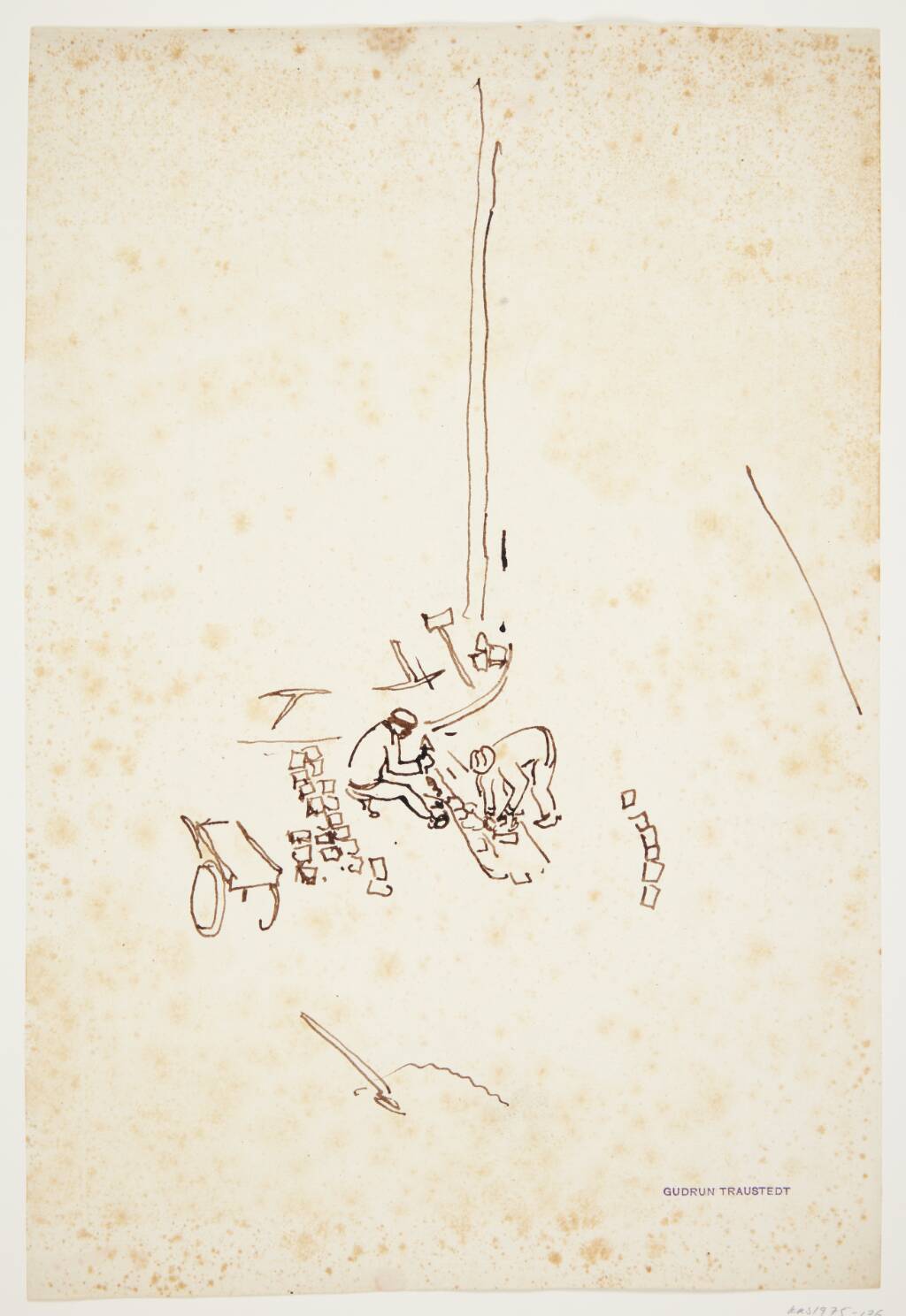
Gadearbejdere
✦ Read about this
"Gadearbejdere" (Street Workers) is a pen drawing in brown ink by the Danish artist Gudrun Traustedt, made between 1920 and 1924. It is held in the collection of the SMK — the National Gallery of Denmark.
The work is executed on paper that now shows yellow spotting, a form of age-related discoloration common to works on paper from this period. The subject—laborers at work in the street—reflects an interest in everyday urban scenes.
Background drawn from SMK — National Gallery of Denmark
Today's poem
The Chimney-Sweeper
When my mother died I was very young, And my father sold me while yet my tongue Could scarcely cry "Weep! weep! weep! weep!" So your chimneys I sweep, and in soot I sleep. There's little Tom Dacre, who cried when his head, That curled like a lamb's back, was shaved; so I said, "Hush, Tom! never mind it, for, when your head's bare, You know that the soot cannot spoil your white hair." And so he was quiet, and that very night, As Tom was a-sleeping, he had such a sight!-- That thousands of sweepers, Dick, Joe, Ned, and Jack, Were all of them locked up in coffins of black. And by came an angel, who had a bright key, And he opened the coffins, and let them all free; Then down a green plain, leaping, laughing, they run, And wash in a river, and shine in the sun. Then naked and white, all their bags left behind, They rise upon clouds, and sport in the wind; And the Angel told Tom, if he'd be a good boy, He'd have God for his father, and never want joy. And so Tom awoke, and we rose in the dark, And got with our bags and our brushes to work. Though the morning was cold, Tom was happy and warm: So, if all do their duty, they need not fear harm.
William Blake · Public domain
✦ Read about this
William Blake was an English poet, painter and printmaker, largely unrecognised in his lifetime but now regarded as a seminal figure in the poetry and visual art of the Romantic Age. He lived in London his entire life except for three years in Felpham, and produced a symbolically rich body of work that treated the imagination as, in his words, "the body of God".
"The Chimney-Sweeper" is spoken by a child sold into the trade after his mother's death, who comforts a younger boy, Tom Dacre, during the horrors of their work. The poem turns on Tom's dream of sweepers locked in black coffins and freed by an angel to wash in a river and rise into the sun.
Written in rhyming couplets and plain, song-like language, the poem sets a child's innocent voice against the cruelty of child labour. Its closing moral—"if all do their duty, they need not fear harm"—carries an irony that sharpens its implicit protest.
Background drawn from PoetryDB & Wikipedia