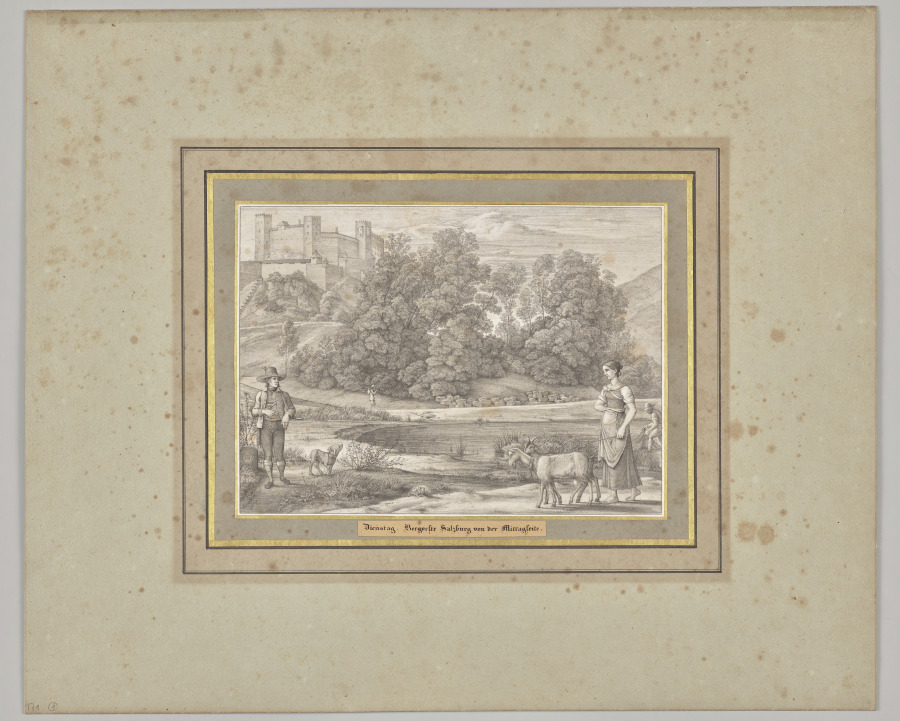
Tuesday. Bergveste Salzburg from the Midday Side
✦ Read about this
This lithograph belongs to an unusual series in which Ferdinand Olivier organized seven views of Salzburg and Berchtesgaden according to the days of the week, binding them together with two allegorical sheets. Its full title, "Seven Areas from Salzburg and Berchtesgaden, Arranged according to the seven days of the week," signals this conceptual structure; the present plate represents Tuesday, showing the fortress of Salzburg from the midday side.
Olivier (1785–1841) was a German painter associated with the Nazarene movement, a group of artists who drew on earlier German and Italian art in pursuit of spiritual and national renewal. He produced the series between 1818 and 1823.
The work is a lithograph, a relatively new printmaking technique at the time, on a sheet measuring 19.5 by 27.5 cm. It entered the Cleveland Museum of Art in 2023 through the John L. Severance Fund.
Background drawn from Cleveland Museum of Art & Wikipedia
Today's poem
An Old Man’s Thought of School
AN old man’s thought of School; An old man, gathering youthful memories and blooms, that youth itself cannot. Now only do I know you! O fair auroral skies! O morning dew upon the grass! And these I see—these sparkling eyes, These stores of mystic meaning—these young lives, Building, equipping, like a fleet of ships—immortal ships! Soon to sail out over the measureless seas, On the Soul’s voyage. Only a lot of boys and girls? Only the tiresome spelling, writing, ciphering classes? Only a Public School? Ah more—infinitely more; (As George Fox rais’d his warning cry, “Is it this pile of brick and mortar—these dead floors, windows, rails—you call the church? Why this is not the church at all—the Church is living, ever living Souls.”) And you, America, Cast you the real reckoning for your present? The lights and shadows of your future—good or evil? To girlhood, boyhood look—the Teacher and the School.
Walt Whitman · Public domain
✦ Read about this
Walt Whitman, often called the father of free verse, wrote this poem in the mode he helped establish in American literature—unrhymed, variable lines keyed to speech and feeling rather than meter. One of the most influential poets in American and world literature, he incorporated both transcendentalism and realism into his work, though his 1855 collection Leaves of Grass was attacked by some as obscene for its sensuality.
"An Old Man's Thought of School" takes the voice of an aged speaker looking back on childhood schooldays, reframing an ordinary public school as something far larger than its lessons and buildings. Whitman compares the pupils to "a fleet of ships" bound for "the Soul's voyage," and quotes the Quaker George Fox to argue that the church is not brick and mortar but "living, ever living Souls."
The poem closes by turning to America, insisting that the nation's future depends on its children, their teachers, and their schools.
Background drawn from PoetryDB & Wikipedia