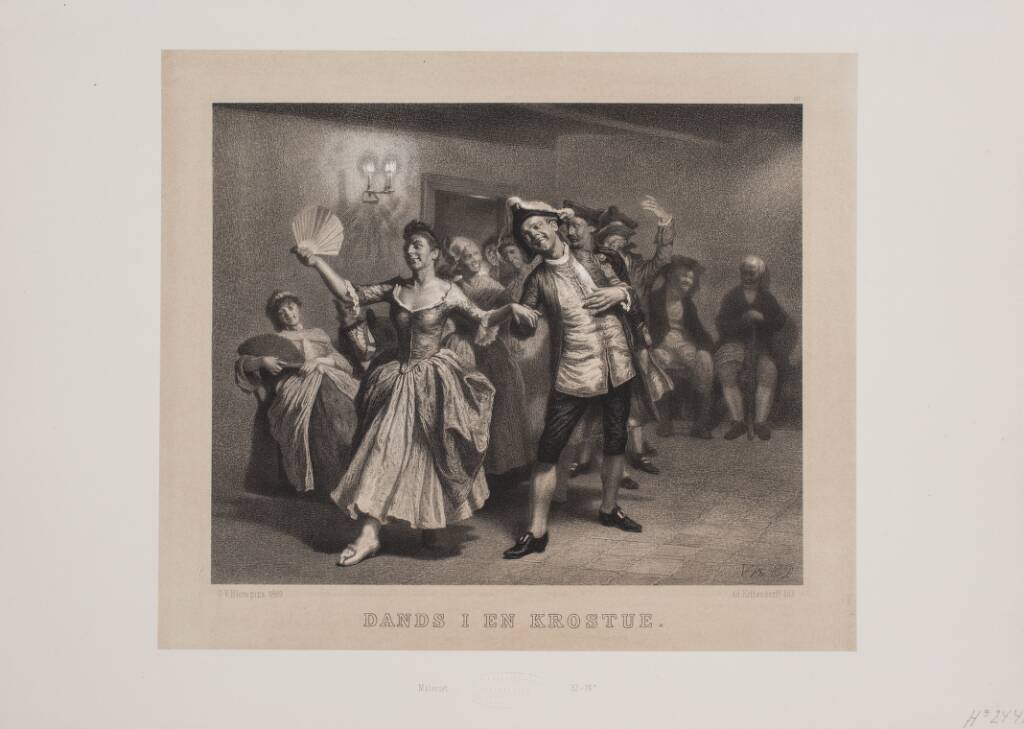
Dans i en krostue
✦ Read about this
"Dans i en krostue" is a color lithograph by the Danish artist Adolph Kittendorff, produced during the 1880s.
The work was made using chromolithography, a technique in which separate stones or plates are used to print successive colors, allowing for multi-colored prints. It depicts a dance in a tavern or inn.
The print is held in the collection of the SMK — National Gallery of Denmark.
Background drawn from SMK — National Gallery of Denmark
Today's poem
I Wandered Lonely As a Cloud
I wandered lonely as a cloud That floats on high o'er vales and hills, When all at once I saw a crowd, A host, of golden daffodils; Beside the lake, beneath the trees, Fluttering and dancing in the breeze. Continuous as the stars that shine And twinkle on the milky way, They stretched in never-ending line Along the margin of a bay: Ten thousand saw I at a glance, Tossing their heads in sprightly dance. The waves beside them danced, but they Out-did the sparkling leaves in glee; A poet could not be but gay, In such a jocund company! I gazed—and gazed—but little thought What wealth the show to me had brought: For oft, when on my couch I lie In vacant or in pensive mood, They flash upon that inward eye Which is the bliss of solitude; And then my heart with pleasure fills, And dances with the daffodils.
William Wordsworth · Public domain
✦ Read about this
William Wordsworth was an English Romantic poet who, with Samuel Taylor Coleridge, helped launch the Romantic Age in English literature through their joint 1798 publication *Lyrical Ballads*. That collaboration made him one of the central figures in the movement that reoriented English poetry toward nature, emotion, and ordinary experience.
"I Wandered Lonely As a Cloud" is among his best-known poems. It is built in four six-line stanzas with a regular rhyme scheme, each closing in a couplet. The poem describes the speaker coming upon a vast stretch of daffodils beside a lake, dancing in the breeze, and compares them to stars along the Milky Way.
Its final turn is characteristic of Wordsworth: the value of the sight lies not in the moment itself but in memory. Later, lying in a "vacant or in pensive mood," the speaker finds the daffodils flashing upon the "inward eye," filling his heart with pleasure—the "bliss of solitude."
Background drawn from PoetryDB & Wikipedia