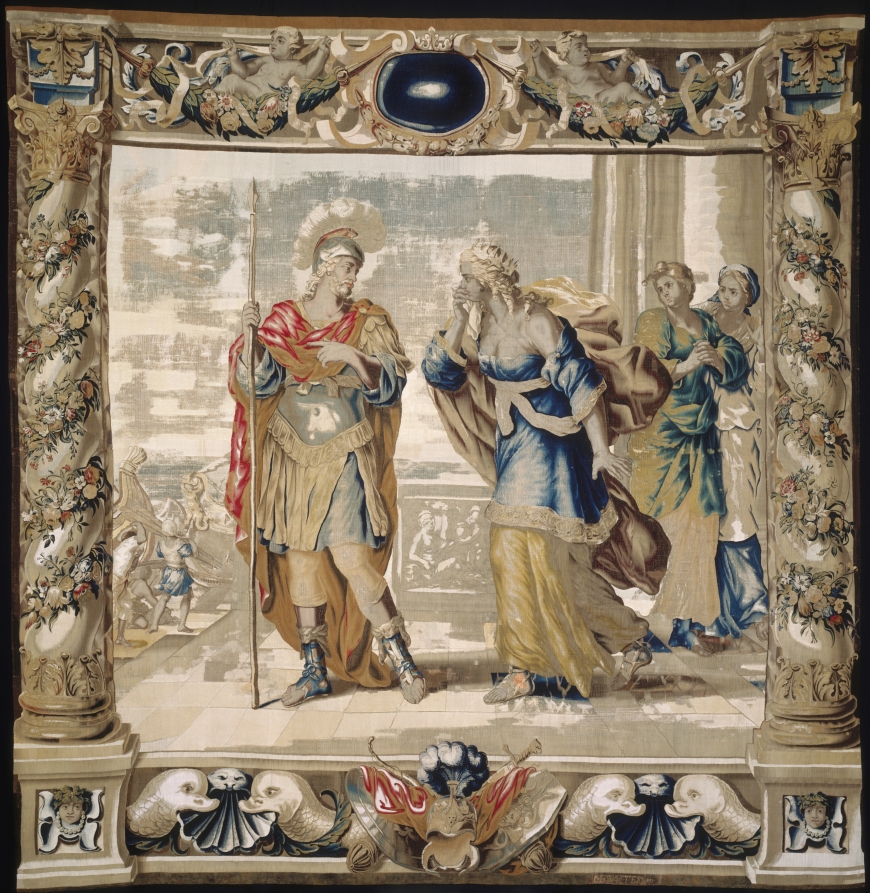
Aeneas says Farewell to Dido
✦ Read about this
Ready to depart on the fleet which you can see behind him, Aeneas tells the distraught Dido that he must follow his destiny and leave Carthage.
Did you know? This tapestry is one from a series of eight that depicts the tragic love story of Dido and Aeneas. They were gifted to the museum for display in the armor court.
Background drawn from Cleveland Museum of Art
Today's poem
A Little Boy Lost
"Nought loves another as itself, Nor venerates another so, Nor is it possible to thought A greater than itself to know. "And, father, how can I love you Or any of my brothers more? I love you like the little bird That picks up crumbs around the door." The Priest sat by and heard the child; In trembling zeal he seized his hair, He led him by his little coat, And all admired the priestly care. And standing on the altar high, "Lo, what a fiend is here!" said he: "One who sets reason up for judge Of our most holy mystery." The weeping child could not be heard, The weeping parents wept in vain: They stripped him to his little shirt, And bound him in an iron chain, And burned him in a holy place Where many had been burned before; The weeping parents wept in vain. Are such thing done on Albion's shore?
William Blake · Public domain
✦ Read about this
William Blake (1757–1827) was an English poet, painter and printmaker, largely unrecognised in his lifetime but now regarded as a seminal figure of the Romantic Age in both poetry and visual art. He lived nearly all his life in London, apart from three years in Felpham, and produced a symbolically rich body of work rooted in the imagination, which he called "the body of God."
"A Little Boy Lost" belongs to Blake's output of densely symbolic verse. In short rhymed quatrains, it tells of a child who argues that no one can love another more than himself, and who likens his love to a bird picking up crumbs. A Priest seizes the boy, denounces him before the congregation as a fiend who "sets reason up for judge" of holy mystery, and has him burned.
The poem attacks organised religion's cruelty and intolerance toward innocence and free thought, closing with the pointed question of whether such things are done on "Albion's shore" — England itself.
Background drawn from PoetryDB & Wikipedia