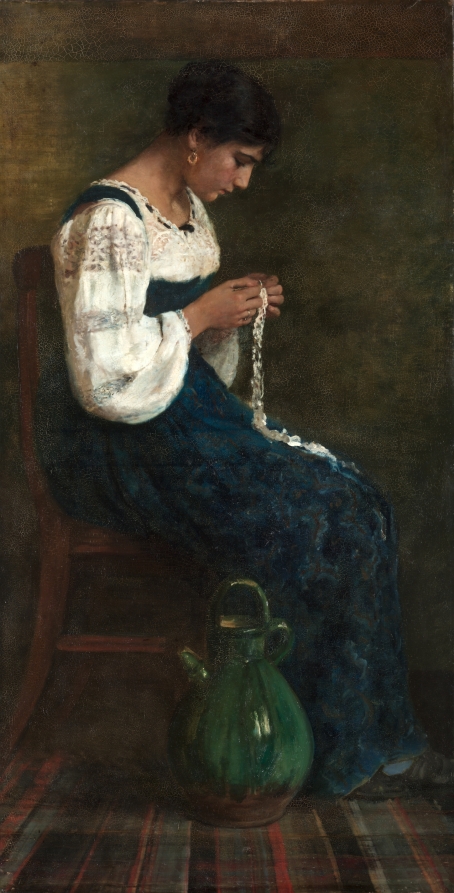
Capri Lace Maker
✦ Read about this
George Butler studied art making in the United States and France, and subsequently lived several years in Italy, where he painted Capri Lace Maker . A gift of the artist's daughter, this work was the first painting to enter the Cleveland Museum of Art's collection, which took place on February 2, 1915.
Did you know? Left-handed George Butler lost his right arm while fighting for the Union Army at the Battle of Gettysburg during the US Civil War.
Background drawn from Cleveland Museum of Art
Today's poem
From Paumanok Starting
FROM Paumanock starting, I fly like a bird, Around and around to soar, to sing the idea of all; To the north betaking myself, to sing there arctic songs, To Kanada, till I absorb Kanada in myself—to Michigan then, To Wisconsin, Iowa, Minnesota, to sing their songs, (they are inimitable;) Then to Ohio and Indiana to sing theirs—to Missouri and Kansas and Arkansas, to sing theirs, To Tennessee and Kentucky—to the Carolinas and Georgia, to sing theirs, To Texas, and so along up toward California, to roam accepted everywhere; To sing first, (to the tap of the war-drum, if need be,) The idea of all—of the western world, one and inseparable. And then the song of each member of These States.
Walt Whitman · Public domain
✦ Read about this
Walt Whitman, often called the father of free verse, built his reputation on *Leaves of Grass*, the collection he first published in 1855 and expanded throughout his life. "From Paumanok Starting" belongs to that project. "Paumanok" is the Native American name for Long Island, where Whitman was born, and the poem takes it as the launching point for a flight across the continent.
The poem is a catalog, a form Whitman used repeatedly: the speaker imagines soaring like a bird to name region after region—Canada, the Great Lakes states, the Midwest, the South, Texas, California—singing the song of each. The accumulating list of place names enacts the poem's central claim.
Its subject is national unity: "the idea of all—of the western world, one and inseparable." The reference to the "war-drum" frames that unity against the possibility of conflict, before the poem turns to "the song of each member of These States."
Background drawn from PoetryDB & Wikipedia