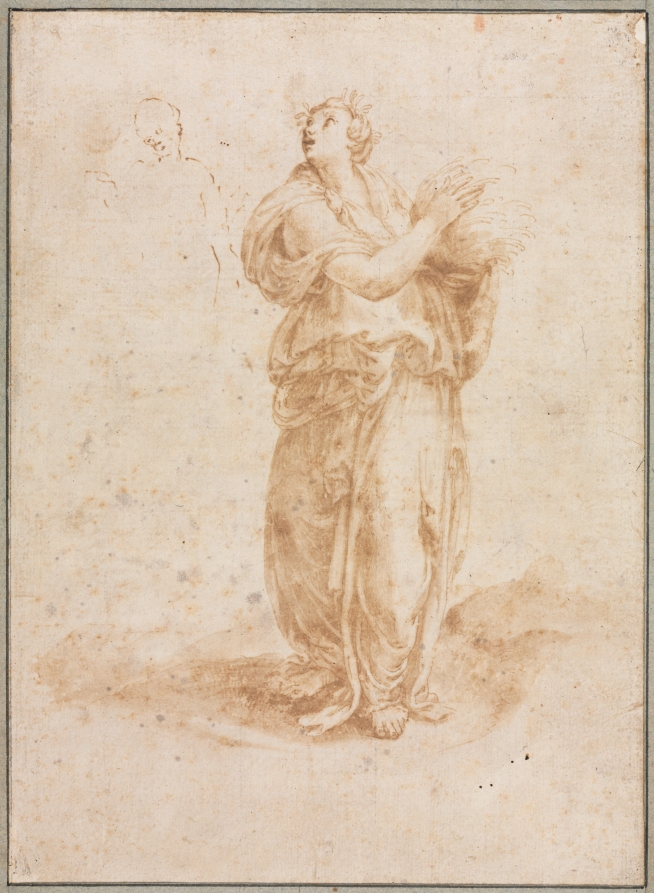
Ceres
✦ Read about this
The physical traces on this sheet reveal its working purpose: it is squared in black chalk and incised, techniques used to transfer a design to a larger surface, indicating it served as a preparatory study rather than a finished drawing.
Lelio Orsi (1511–1587), also known as Lelio da Novellara, was a Mannerist painter and architect associated with the Reggio Emilia school in northern Italy. The drawing of Ceres, the Roman goddess of agriculture, dates to the 16th century and was executed in pen and brown ink with brush and brown wash, with framing lines added in graphite along the left and bottom edges.
The sheet measures 25.6 by 18.7 cm and is mounted on a secondary support. It entered the Cleveland Museum of Art in 1939 as a gift of Robert Hays Gries.
Background drawn from Cleveland Museum of Art & Wikipedia
Today's poem
To a Locomotive in Winter
THEE for my recitative! Thee in the driving storm, even as now—the snow—the winter-day declining; Thee in thy panoply, thy measured dual throbbing, and thy beat convulsive; Thy black cylindric body, golden brass, and silvery steel; Thy ponderous side-bars, parallel and connecting rods, gyrating, shuttling at thy sides; Thy metrical, now swelling pant and roar—now tapering in the distance; Thy great protruding head-light, fix’d in front; Thy long, pale, floating vapor-pennants, tinged with delicate purple; The dense and murky clouds out-belching from thy smoke-stack; Thy knitted frame—thy springs and valves—the tremulous twinkle of thy wheels; Thy train of cars behind, obedient, merrily-following, Through gale or calm, now swift, now slack, yet steadily careering: Type of the modern! emblem of motion and power! pulse of the continent! For once, come serve the Muse, and merge in verse, even as here I see thee, With storm, and buffeting gusts of wind, and falling snow; By day, thy warning, ringing bell to sound its notes, By night, thy silent signal lamps to swing. Fierce-throated beauty! Roll through my chant, with all thy lawless music! thy swinging lamps at night; Thy piercing, madly-whistled laughter! thy echoes, rumbling like an earthquake, rousing all! Law of thyself complete, thine own track firmly holding; (No sweetness debonair of tearful harp or glib piano thine,) Thy trills of shrieks by rocks and hills return’d, Launch’d o’er the prairies wide—across the lakes, To the free skies, unpent, and glad, and strong.
Walt Whitman · Public domain
✦ Read about this
Walt Whitman, often called the father of free verse, wrote this poem as a direct address to a steam locomotive, which he hails as the "Type of the modern! emblem of motion and power! pulse of the continent!" The poem celebrates industrial machinery in the same expansive, catalog-driven style Whitman applied to the human body and the American landscape elsewhere in his work.
Whitman was an American poet, essayist, and journalist considered among the most influential poets in American and world literature. His writing combined transcendentalism and realism, and his 1855 collection Leaves of Grass drew controversy, condemned by some as obscene for its sensuality.
The poem unfolds as a single sustained apostrophe, piling up physical details—the black cylindric body, the side-bars and connecting rods, the vapor pennants and head-light—before shifting to praise the engine's "lawless music" and "fierce-throated beauty." Whitman explicitly contrasts the locomotive's harsh sounds with the "sweetness debonair of tearful harp or glib piano," presenting the machine as self-sufficient and triumphant.
Background drawn from PoetryDB & Wikipedia