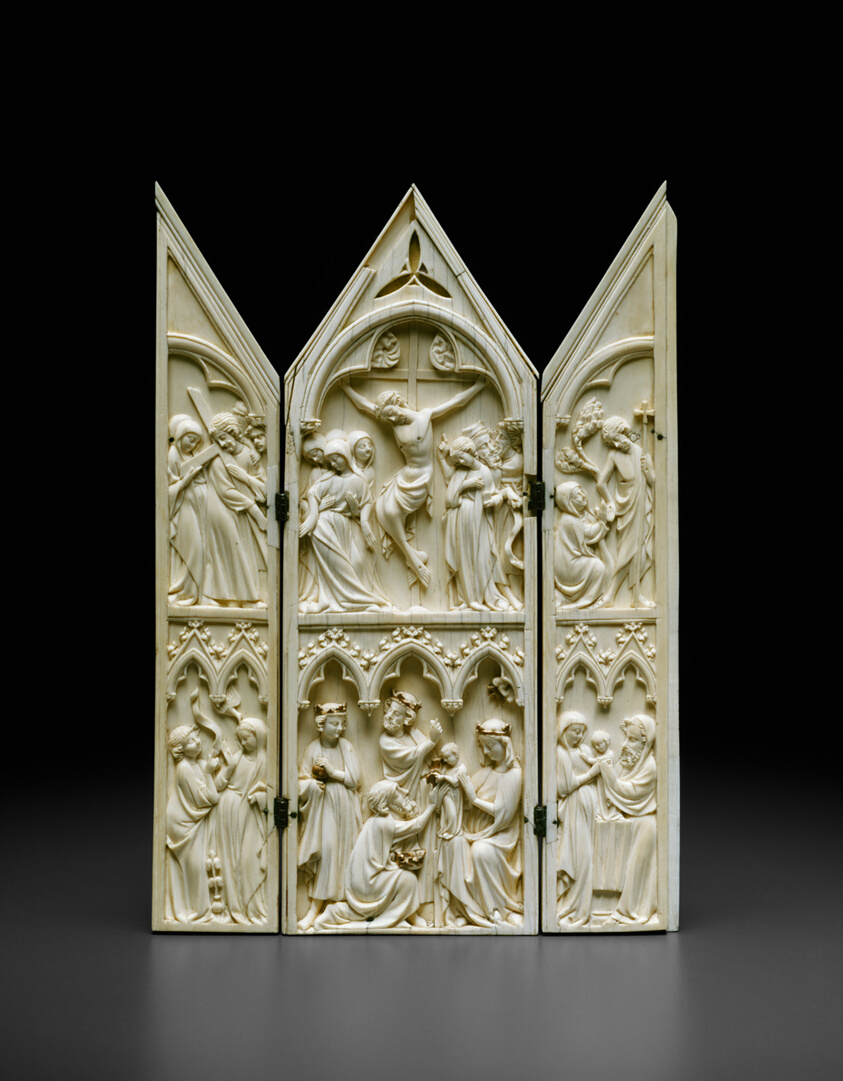
Triptych with Scenes from the Life of Christ
✦ Read about this
Ivory was used to make highly prized devotional objects in the Gothic era. This triptych features scenes from the infancy and Passion of Christ, arranged in a chronological sequence from left to right, starting at the bottom with the Annunciation, the Adoration of the Magi, and the Presentation in the Temple. The narrative continues in the top register with the Road to Calvary, Christ on the Cross, and the encounter of Christ and Mary Madgalen after the Resurrection. Such small devotional objects might be kept on a stand or cabinet in a bedroom, ready to be used as a focus for prayer by the layperson who owned them, along with an illuminated Psalter or Book of Hours. The intimate scale and movable wings of the triptych made it easy to store in a chest or to carry from one residence to another as needed. Although Paris has long been recognized as a great center for ivory carving in the Gothic era, recent scholarship has also emphasized the importance of workshops in England, Germany, and Italy—affirming the popularity of the medium throughout medieval Europe. This triptych was most likely made by a master artist and his atelier working in Germany, probably in Cologne.
Background drawn from Art Institute of Chicago
Today's poem
I heard a fly buzz when I died
I heard a fly buzz when I died; The stillness round my form Was like the stillness in the air Between the heaves of storm. The eyes beside had wrung them dry, And breaths were gathering sure For that last onset, when the king Be witnessed in his power. I willed my keepsakes, signed away What portion of me I Could make assignable, -- and then There interposed a fly, With blue, uncertain, stumbling buzz, Between the light and me; And then the windows failed, and then I could not see to see.
Emily Dickinson · Public domain
✦ Read about this
Emily Dickinson wrote prolifically but published almost nothing during her lifetime; fewer than a dozen of her poems appeared in print before her death, and she was largely unknown as a poet. Her work is now regarded as canonical, with the Poetry Foundation crediting her with "a distinctively elliptical language for expressing what was possible but not yet realized."
"I heard a fly buzz when I died" is spoken from beyond death by a narrator who recounts her own final moments. The scene is conventional in its details—mourners with dried eyes, the willing away of keepsakes, the expectation that death ("the king") will arrive in solemn power—but that expectation is undercut by the intrusion of an ordinary fly with its "blue, uncertain, stumbling buzz."
Formally the poem uses Dickinson's characteristic ballad-like quatrains and dashes. Its final lines, as the "windows failed" and the speaker "could not see to see," register the moment of death through failing perception rather than any revelation.
Background drawn from PoetryDB & Wikipedia