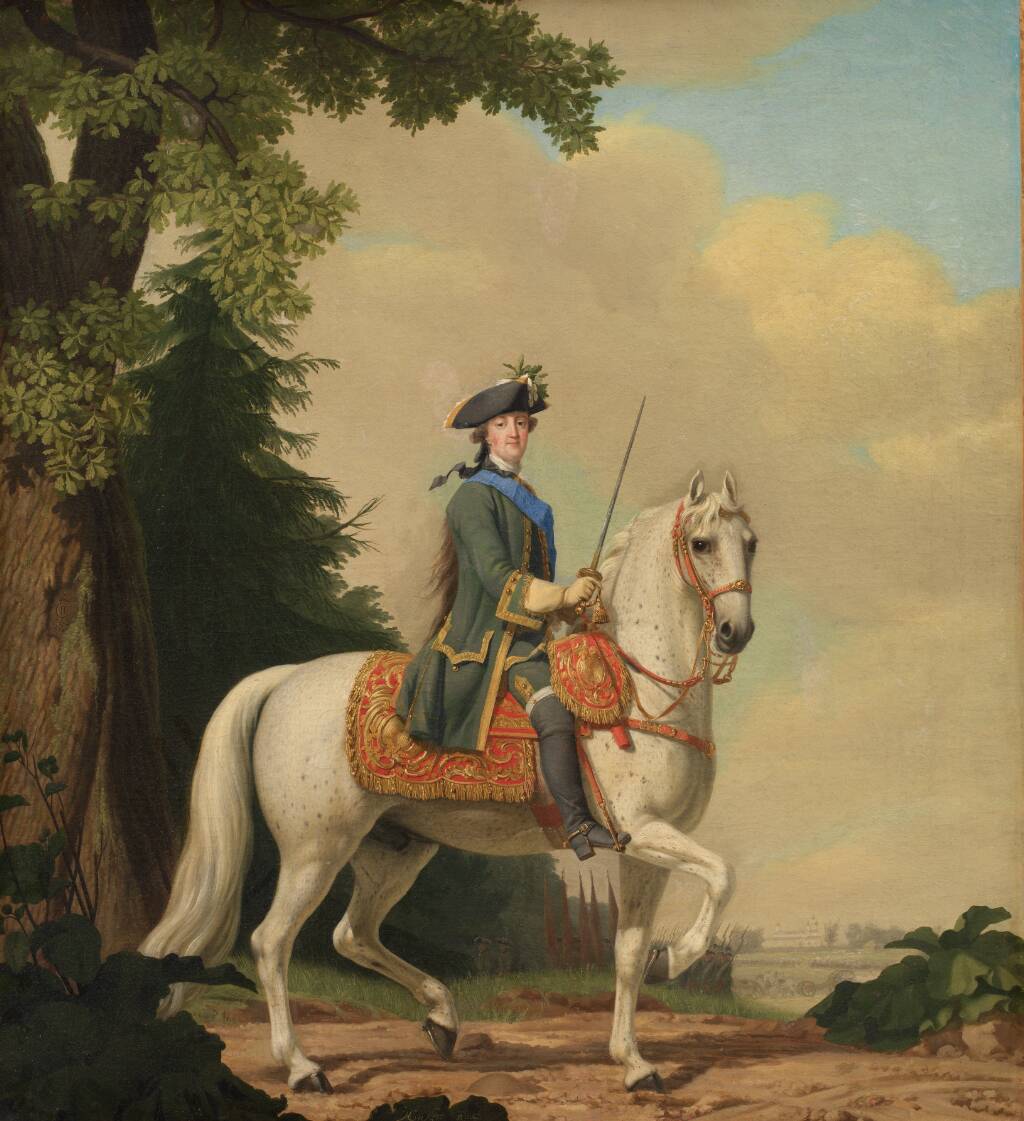
Katharina II af Rusland, ridende i garderuniform på hesten Brillante, den 28. juni 1762
✦ Read about this
The portrait commemorates a specific date: 28 June 1762, when Catherine II of Russia rode at the head of the guards in the coup that deposed her husband, Peter III, and brought her to the throne. She is shown in guards' uniform on her horse Brillante.
Vigilius Eriksen was a Danish painter who served as court portraitist to Christian VI of Denmark. He also worked in Russia, where portraits such as this one brought him into contact with Catherine's court.
The painting was completed in 1782, two decades after the events it depicts, in oil on canvas. It is held by the SMK — National Gallery of Denmark.
Background drawn from SMK — National Gallery of Denmark & Wikipedia
Today's poem
Essential oils are wrung
Essential oils are wrung: The attar from the rose Is not expressed by suns alone, It is the gift of screws. The general rose decays; But this, in lady's drawer, Makes summer when the lady lies In ceaseless rosemary.
Emily Dickinson · Public domain
✦ Read about this
Emily Dickinson wrote prolifically but published almost nothing in her lifetime; fewer than a dozen of her poems appeared in print before her death, and she was essentially unknown as a poet. Her work was only later recognized as central to American literature. The Poetry Foundation credits her with creating "a distinctively elliptical language for expressing what was possible but not yet realized."
This short poem exemplifies that compression. In two quatrains it draws an analogy from perfume-making: the rose's attar, its essential oil, is not produced by sunlight alone but by pressure—"the gift of screws." The ordinary rose decays, but the distilled essence, kept in a drawer, outlasts it.
The second stanza turns the figure toward death: the oil "makes summer" even after the lady lies in "ceaseless rosemary." Dickinson suggests that something essential—memory, poetry, the self—is extracted and preserved precisely through hardship and loss.
Background drawn from PoetryDB & Wikipedia