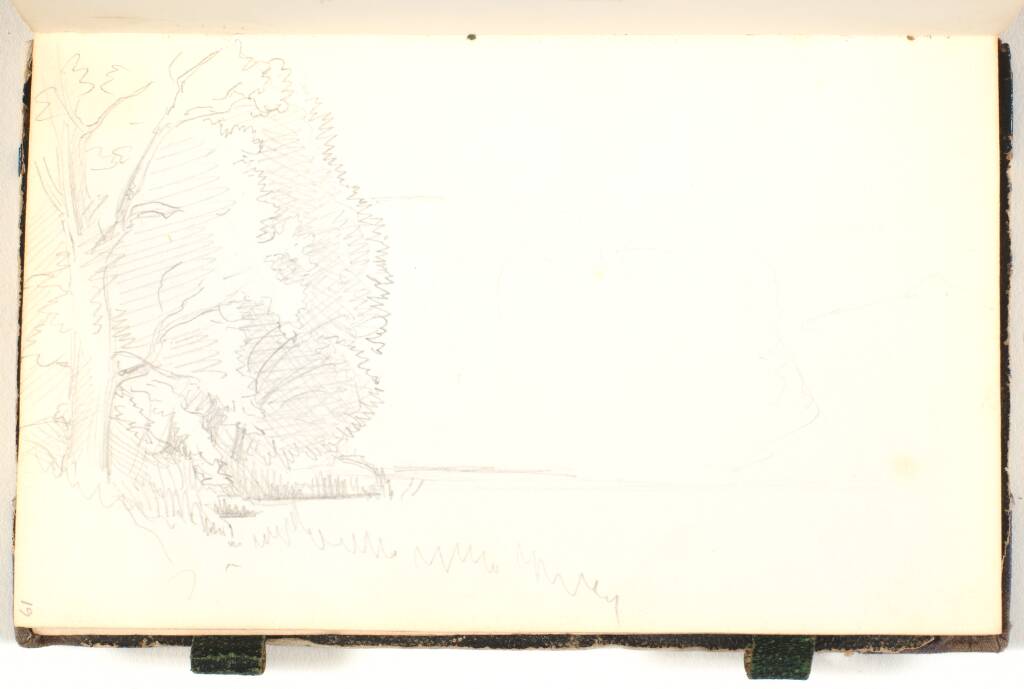
Skovparti
✦ Read about this
This drawing is a work on paper in pencil (blyant), a medium distinct from the large-scale oil paintings for which P.C. Skovgaard is best known. Such studies formed part of the working practice behind his finished landscapes.
P.C. Skovgaard (Peter Christian Thamsen Skovgaard) was a Danish national romantic landscape painter and one of the central figures of the Golden Age of Danish Painting. He is regarded as among the leading landscape painters of the 19th century, especially recognized for his large-scale depictions of the Danish countryside.
"Skovparti," a woodland scene, was made in 1865 and is held in the collection of SMK — the National Gallery of Denmark.
Background drawn from SMK — National Gallery of Denmark & Wikipedia
Today's poem
An altered look about the hills
An altered look about the hills; A Tyrian light the village fills; A wider sunrise in the dawn; A deeper twilight on the lawn; A print of a vermilion foot; A purple finger on the slope; A flippant fly upon the pane; A spider at his trade again; An added strut in chanticleer; A flower expected everywhere; An axe shrill singing in the woods; Fern-odors on untravelled roads, -- All this, and more I cannot tell, A furtive look you know as well, And Nicodemus' mystery Receives its annual reply.
Emily Dickinson · Public domain
✦ Read about this
Emily Dickinson (1830–1886) was an American poet who published almost nothing in her lifetime and was unknown as a writer while she lived; her work is now considered canonical. The Poetry Foundation credits her with creating "a distinctively elliptical language for expressing what was possible but not yet realized."
This poem catalogs the signs of spring's arrival through a series of precise images: a changed appearance of the hills, a "Tyrian" (purple) light over the village, a wider sunrise, the return of the spider and the fly, the crowing rooster, and the smell of ferns on back roads. The accumulation of observations builds toward a single seasonal event.
The poem is composed in rhymed couplets. Its closing lines turn the natural description toward religious allusion: the reference to Nicodemus—who in John's Gospel questions how a man can be born again—frames spring's return as the "annual reply" to that mystery of rebirth.
Background drawn from PoetryDB & Wikipedia