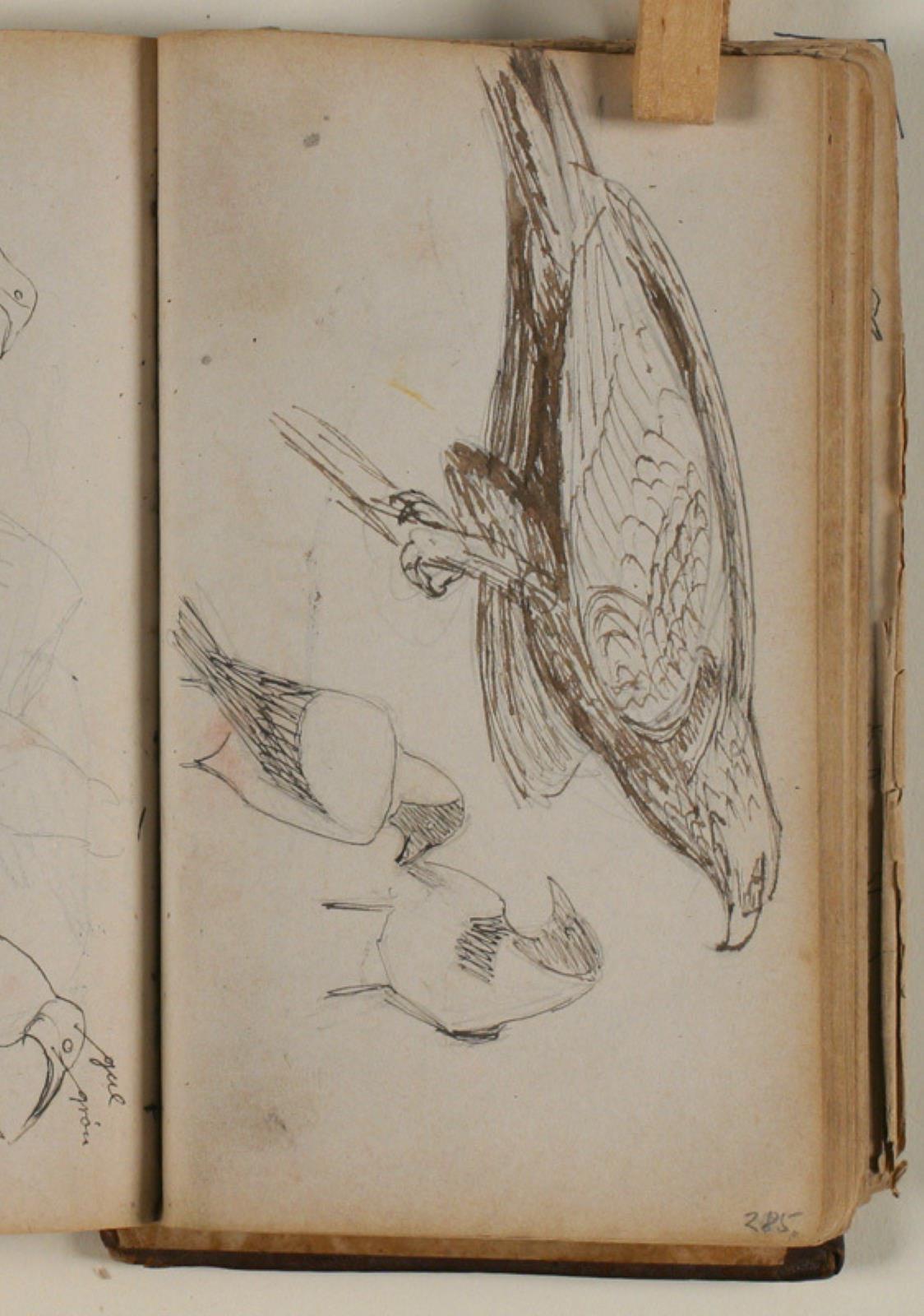
Studier af ørn og krager
✦ Read about this
*Studier af ørn og krager* ("Studies of Eagle and Crows") is a drawing by the Danish painter and sculptor Niels Larsen Stevns (1864–1941), held at the National Gallery of Denmark (SMK). It is worked in pen and brown ink over an underdrawing in pencil.
Stevns trained first as a journeyman painter before studying at the Kunstakademiet in Copenhagen during 1886–1887 and again in 1892–1894. He is particularly associated with his work assisting Joakim Skovgaard on the decoration of Viborg Cathedral, carried out in a simplified manner drawn from early Christian and Byzantine art.
This sheet belongs to the tradition of the artist's study drawings, in which birds are observed and recorded directly in ink and pencil.
Background drawn from SMK — National Gallery of Denmark & Wikipedia
Today's poem
In Drear-Nighted December
In drear-nighted December, Too happy, happy tree, Thy branches ne'er remember Their green felicity: The north cannot undo them With a sleety whistle through them; Nor frozen thawings glue them From budding at the prime. In drear-nighted December, Too happy, happy brook, Thy bubblings ne'er remember Apollo's summer look; But with a sweet forgetting, They stay their crystal fretting, Never, never petting About the frozen time. Ah! would 'twere so with many A gentle girl and boy! But were there ever any Writhed not at passed joy? The feel of not to feel it, When there is none to heal it Nor numbed sense to steel it, Was never said in rhyme.
John Keats · Public domain
✦ Read about this
John Keats was an English poet of the second generation of Romantic poets, alongside Byron and Shelley. His poems had been in publication for less than four years when he died of tuberculosis at the age of 25, and they were received indifferently in his lifetime. His reputation grew rapidly after his death, and by the end of the nineteenth century he held a secure place in the English canon, influencing the Pre-Raphaelite Brotherhood.
"In Drear-Nighted December" contrasts the unconscious endurance of nature with human memory. The tree and the brook pass through winter without recalling their summer vigor, feeling no pain at what is lost. People cannot do the same: they "writhe at passed joy."
The poem is built on parallel stanzas, each opening with the same line and moving from tree to brook to human beings. Its closing turn fixes on the particular anguish of remembered happiness—"The feel of not to feel it"—which Keats claims had never before been captured in verse.
Background drawn from PoetryDB & Wikipedia