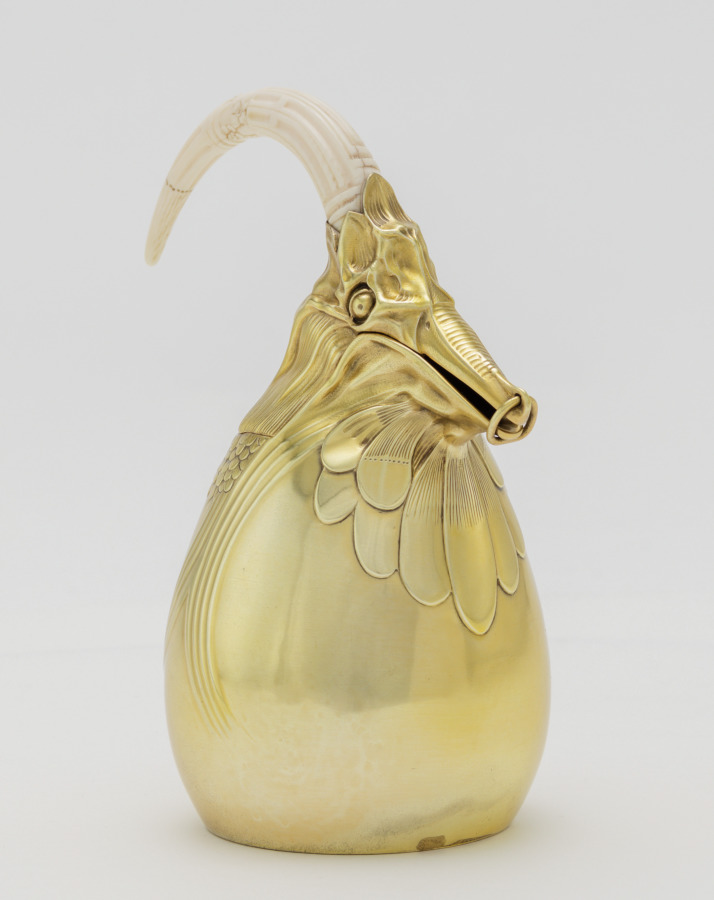
Coffee Pot
✦ Read about this
This tea and coffee service, salver, and table, together with some now missing cups, were all designed by Carlo Bugatti as an ensemble and presented at the 1902 exposition devoted to decorative arts in Turin, Italy. The set was probably acquired from Bugatti's 1907 exhibition at the Galerie Hébrard in Paris by a wealthy South African widow, Anna Blake, who was living there at the time. Some of the animal and insect motifs suggest mythical beasts or the fossils of prehistoric animals. When Mrs. Blake returned to Cape Town, she took these and other pieces designed by Bugatti with her, and they remained in South Africa throughout her lifetime.
Did you know? This coffee pot is part of a larger tea and coffee service designed by Carlo Bugatti.
Background drawn from Cleveland Museum of Art
Today's poem
The Garden of Love
I laid me down upon a bank, Where Love lay sleeping; I heard among the rushes dank Weeping, weeping. Then I went to the heath and the wild, To the thistles and thorns of the waste; And they told me how they were beguiled, Driven out, and compelled to the chaste. I went to the Garden of Love, And saw what I never had seen; A Chapel was built in the midst, Where I used to play on the green. And the gates of this Chapel were shut And "Thou shalt not," writ over the door; So I turned to the Garden of Love That so many sweet flowers bore. And I saw it was filled with graves, And tombstones where flowers should be; And priests in black gowns were walking their rounds, And binding with briars my joys and desires.
William Blake · Public domain
✦ Read about this
William Blake was an English poet, painter and printmaker now regarded as a seminal figure of the Romantic Age, though he went largely unrecognised in his own lifetime. He lived in London his entire life, apart from three years in Felpham, and produced a symbolically rich body of work that treated the imagination as "the body of God" and "human existence itself." The 20th-century critic Northrop Frye called his self-styled "prophetic works" the least read body of poetry in English relative to its merits.
"The Garden of Love" sets religious institution against natural desire. The speaker returns to a childhood green to find it replaced by a Chapel with "Thou shalt not" above its shut gates, and the garden itself turned to graves and tombstones, patrolled by priests in black gowns "binding with briars" his joys and desires. The poem's plain quatrains and expanding final lines carry an attack on organised religion as repressive of love and liberty.
Background drawn from PoetryDB & Wikipedia