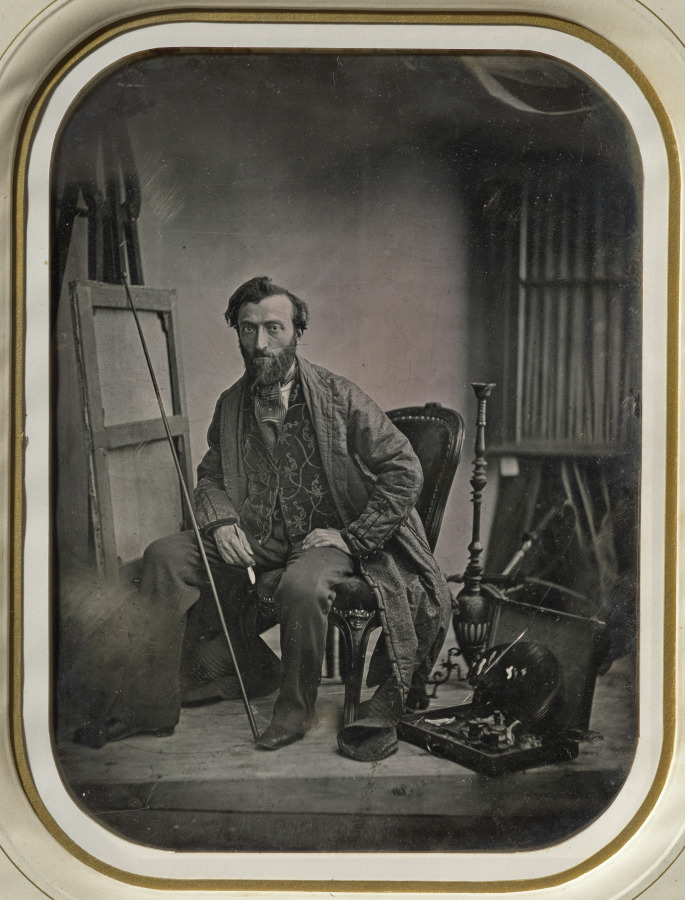
Self-Portrait in Painting Studio
✦ Read about this
Dolard, a portrait painter, may have offered photographs to prospective clients of lesser means. In this image, possibly made as an advertisement for his studio, he identifies himself as a painter, surrounded by the tools of the trade. The coat and the hookah suggest an interest in orientalism, a fashion that occupied many mid-19th-century artists. A remarkable technical achievement, this whole-plate image required Dolard to remain motionless for well over a minute, at least 30 times longer than the exposure for the smaller plates in the case below.
Did you know? Many of the best early photographers were painters who put their training in figural arrangement, light and shadow, and composition to good use in the new medium.
Background drawn from Cleveland Museum of Art
Today's poem
Spring Quiet
Gone were but the Winter, Come were but the Spring, I would go to a covert Where the birds sing; Where in the whitethorn Singeth a thrush, And a robin sings In the holly-bush. Full of fresh scents Are the budding boughs Arching high over A cool green house: Full of sweet scents, And whispering air Which sayeth softly: "We spread no snare; "Here dwell in safety, Here dwell alone, With a clear stream And a mossy stone. "Here the sun shineth Most shadily; Here is heard an echo Of the far sea, Though far off it be."
Christina Rossetti · Public domain
✦ Read about this
Christina Rossetti (English) wrote romantic and devotional poems, among them the narrative "Goblin Market" and the sonnet "Remember." "Spring Quiet" belongs to the same body of work, though cast in a lighter, lyric mode.
The poem imagines escape from winter into a secluded spring landscape — a "covert" of whitethorn and holly where a thrush and robin sing, boughs arch into a "cool green house," and a clear stream runs over a mossy stone. In its closing stanzas the setting itself speaks, promising safety and solitude ("We spread no snare") and an echo of the distant sea.
The form is short, with brief rhymed stanzas and simple diction. The archaic verbs ("singeth," "sayeth," "shineth") lend it a deliberately old-fashioned cadence. The subject is retreat and refuge: a wished-for place of quiet set against the winter the speaker wants to leave behind.
Background drawn from PoetryDB & Wikipedia