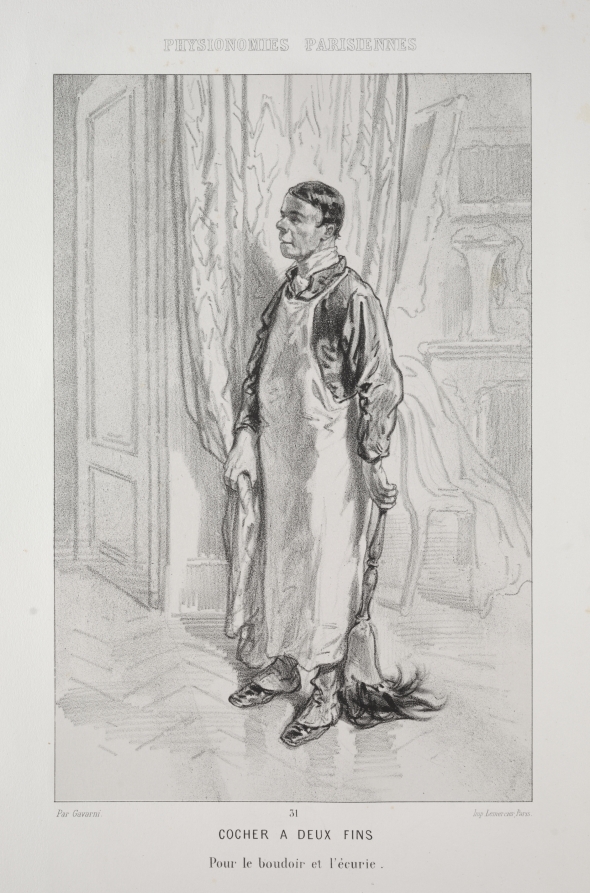
Cocher à deux Fins
✦ Read about this
Paul Gavarni was the pen name of Sulpice Guillaume Chevalier (1804–1866), a French illustrator born in Paris. "Cocher à deux Fins," made around 1857–58, is a lithograph in the collection of the Cleveland Museum of Art.
Lithography, a printmaking technique based on the mutual repulsion of oil and water, allowed artists to draw directly on a prepared stone and produce multiple impressions, making it well suited to the illustration and satirical prints that circulated widely in nineteenth-century France.
The Cleveland impression entered the museum in 1924 through the Charles W. Harkness Endowment Fund.
Background drawn from Cleveland Museum of Art & Wikipedia
Today's poem
A Birthday
My heart is like a singing bird Whose nest is in a water'd shoot; My heart is like an apple-tree Whose boughs are bent with thickset fruit; My heart is like a rainbow shell That paddles in a halcyon sea; My heart is gladder than all these Because my love is come to me. Raise me a dais of silk and down; Hang it with vair and purple dyes; Carve it in doves and pomegranates, And peacocks with a hundred eyes; Work it in gold and silver grapes, In leaves and silver fleurs-de-lys; Because the birthday of my life Is come, my love is come to me.
Christina Rossetti · Public domain
✦ Read about this
Christina Georgina Rossetti was an English writer of romantic and devotional poems, among them "Goblin Market" and "Remember." "A Birthday" belongs to her body of romantic verse.
The poem is built across two stanzas of eight lines each, structured around repetition and accumulation. The first stanza piles up a series of similes — the heart compared to a singing bird, an apple-tree heavy with fruit, a rainbow shell — before concluding that the heart is gladder than all of these. The second stanza shifts from natural imagery to the ornate and man-made, calling for a dais of silk, carvings of doves and pomegranates, peacocks, and work in gold and silver.
Its subject is the joy of love fulfilled. The "birthday" of the title is figurative: the arrival of the beloved marks a new beginning, and both stanzas close on the refrain that "my love is come to me."
Background drawn from PoetryDB & Wikipedia