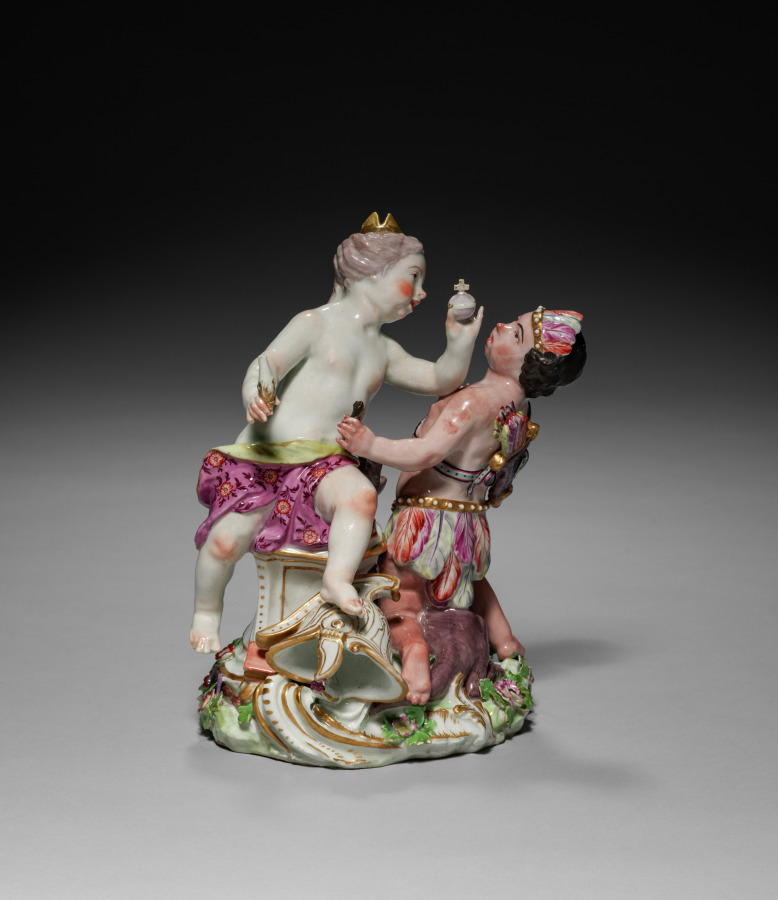
Figure of Europe and America from the Four Continents
✦ Read about this
Often collected by wealthy British merchants who were beneficiaries of colonial expansion, figural groups were frequently part of elaborate table decorations meant to signify wealth and global dominance. Here, Europe is seen holding an orb and wearing a crown as queen of the world, suggesting Europe’s supremacy over the other continents. She is entangled with America, who is wearing feathers with a bow and arrow at her feet. This depiction of America reveals a purely imagined understanding of faraway places.
Did you know? Figural representations of the four continents date back to the 1500s, but such imagery became even more popular in the 1700s as European empires expanded.
Background drawn from Cleveland Museum of Art
Today's poem
Primeval my Love for the Woman I Love
PRIMEVAL my love for the woman I love, O bride! O wife! more resistless, more enduring than I can tell, the thought of you! Then separate, as disembodied, the purest born, The ethereal, the last athletic reality, my consolation, I ascend—I float in the regions of your love, O man, O sharer of my roving life.
Walt Whitman · Public domain
✦ Read about this
Walt Whitman (1819–1892), American poet, essayist, and journalist, is often called the father of free verse and ranks among the most influential poets in American and world literature. He blended transcendentalism and realism, and his work provoked controversy in his lifetime: his 1855 collection *Leaves of Grass* was condemned by some as obscene for its overt sensuality.
This short poem reflects that frankness about desire. It moves from love for a woman—"O bride! O wife!"—to love for a man, "O sharer of my roving life," addressing both with the same directness. The language of ascent and floating "in the regions of your love" sets physical attachment alongside something the speaker calls ethereal and "primeval."
Written in Whitman's characteristic free verse, the poem relies on exclamation and apostrophe rather than regular meter or rhyme, with its lines expanding and contracting to follow the speaker's feeling.
Background drawn from PoetryDB & Wikipedia