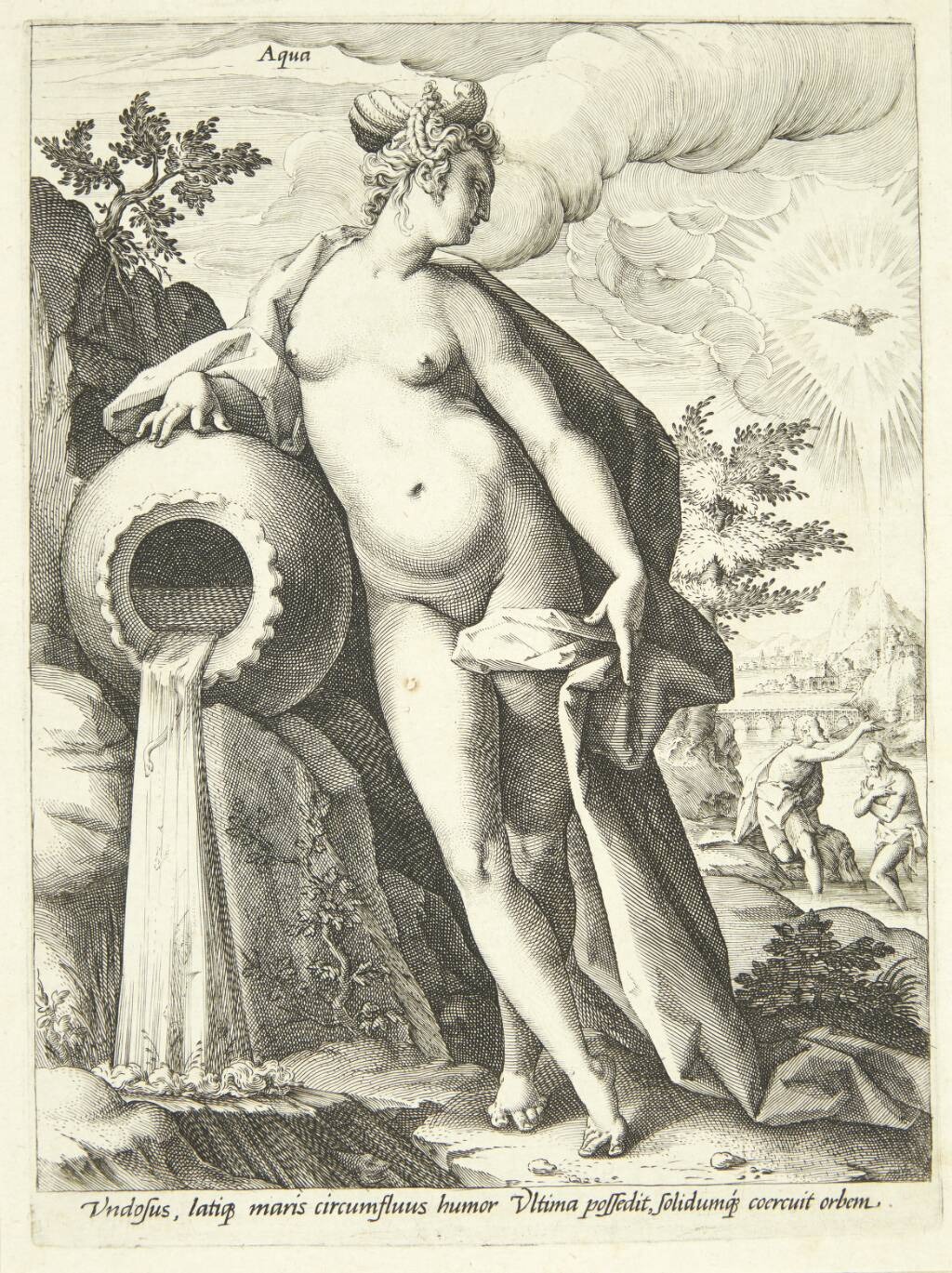
Vand (Aqua)
✦ Read about this
Vand (Aqua) is a copperplate engraving dated 1586, part of a long tradition of allegorical images personifying the four elements. The attribution remains unknown; the print is catalogued under the Danish designation "Ubekendt" (unidentified artist).
Engraving on copper was the dominant technique for reproducible imagery in the late sixteenth century, allowing fine linear detail through incised lines filled with ink. Such prints frequently circulated in series, with Water typically accompanied by companion plates representing Earth, Air, and Fire.
The sheet is held in the collection of the Statens Museum for Kunst (SMK), the National Gallery of Denmark.
Background drawn from SMK — National Gallery of Denmark
Today's poem
Who robbed the woods
Who robbed the woods, The trusting woods? The unsuspecting trees Brought out their burrs and mosses His fantasy to please. He scanned their trinkets, curious, He grasped, he bore away. What will the solemn hemlock, What will the fir-tree say?
Emily Dickinson · Public domain
✦ Read about this
Emily Dickinson published almost nothing during her lifetime and was largely unknown as a poet; the roughly 1,800 poems found after her death have since made her a canonical figure in American literature. The Poetry Foundation credits her with creating "a distinctively elliptical language for expressing what was possible but not yet realized."
"Who robbed the woods" is characteristic of her compact, riddling manner. Across nine short lines it personifies the forest as "trusting" and "unsuspecting," offering up its burrs and mosses to a visitor who examines, grasps, and carries them away.
The poem turns on an implicit accusation: the title names the act as robbery, and the closing questions—what the hemlock and fir will "say"—leave the intruder's guilt hanging unresolved. Its brevity, personification of nature, and open-ended final questions are all typical of Dickinson's method.
Background drawn from PoetryDB & Wikipedia