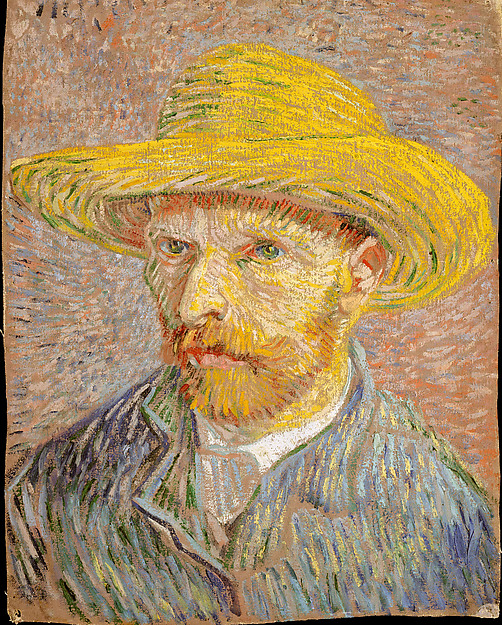
Self-Portrait with a Straw Hat (obverse: The Potato Peeler)
✦ Read about this
This canvas carries two paintings in one: the self-portrait in a straw hat on the front, and an earlier image of a potato peeler on the reverse. Van Gogh frequently reused canvases during periods of poverty, painting a new composition over or on the back of an older one.
He made the work in 1887 in Paris, where he had moved to join his brother Theo. There he encountered Impressionism and Neo-Impressionism, and his palette brightened dramatically from the dark earth tones of his Dutch years—a shift visible in the lighter colors and broken, directional brushwork here. He produced numerous self-portraits during this period, partly because models were a cost he could not afford.
Van Gogh (1853–1890) created roughly 2,100 works in little more than a decade, most in his final two years. The painting entered The Met through the 1967 bequest of Adelaide Milton de Groot.
Background drawn from The Met & Wikipedia
Today's poem
The Child Is Father to the Man
'The child is father to the man.' How can he be? The words are wild. Suck any sense from that who can: 'The child is father to the man.' No; what the poet did write ran, 'The man is father to the child.' 'The child is father to the man!' How can he be? The words are wild.
Gerard Manley Hopkins · Public domain
✦ Read about this
Gerard Manley Hopkins was an English poet and Jesuit priest whose work went largely unread in his lifetime but later established him as a prosodic innovator, best known for his concept of sprung rhythm and for his vivid natural imagery in praise of God.
This short poem is a triolet, a fixed eight-line form built on two repeated lines and a tight rhyme scheme. Hopkins turns the form's repetitions into an argument, worrying at a single borrowed line and its reversal across the poem.
The piece takes as its subject a famous phrase — "The child is father to the man" — and treats it as nonsense, insisting the poet actually wrote the reverse. The result is a playful, contrarian exercise in logic and misquotation, using the triolet's circling structure to press the paradox rather than resolve it.
Background drawn from PoetryDB & Wikipedia