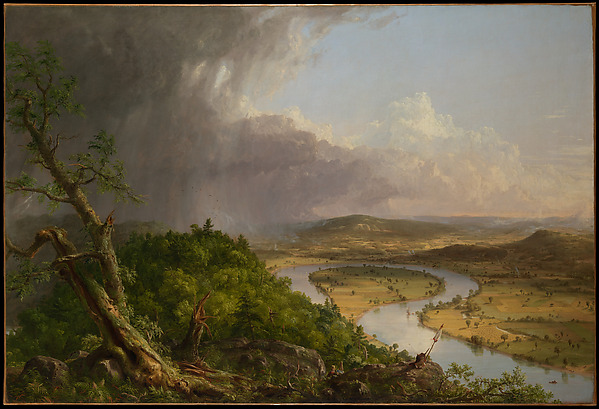
View from Mount Holyoke, Northampton, Massachusetts, after a Thunderstorm—The Oxbow
✦ Read about this
Thomas Cole divided this large canvas—known simply as "The Oxbow"—along a diagonal that splits wild nature from cultivated land: the left side is a dark, storm-torn wilderness, the right an ordered valley of farms bathed in clearing light. The distinctive oxbow bend of the Connecticut River, seen from Mount Holyoke, anchors the cultivated half. Cole himself appears as a small figure with an easel in the middle distance.
Cole (1801–1848), born in Lancashire, England, and later based in Catskill, New York, founded the Hudson River School, the first major American landscape movement. He drew on European Romantic painting but applied it to American scenery and themes, working primarily in oil.
Painted in 1836, the work reflects contemporary debates about westward expansion and the transformation of the American landscape. It entered The Met in 1908 as a gift of Mrs. Russell Sage and hangs in the American Wing.
Background drawn from The Met & Wikipedia
Today's poem
Songs of Experience: Introduction
Hear the voice of the Bard, Who present, past, and future, sees; Whose ears have heard The Holy Word That walked among the ancient tree; Calling the lapsed soul, And weeping in the evening dew; That might control The starry pole, And fallen, fallen light renew! "O Earth, O Earth, return! Arise from out the dewy grass! Night is worn, And the morn Rises from the slumbrous mass. "Turn away no more; Why wilt thou turn away? The starry floor, The watery shore, Are given thee till the break of day."
William Blake · Public domain
✦ Read about this
William Blake was an English poet, painter and printmaker who went largely unrecognised in his lifetime but became a central figure of the Romantic Age. He produced work in which text and image were combined through his own printmaking methods, and his self-styled "prophetic works" were described by the critic Northrop Frye as, in proportion to their merits, the least read body of poetry in English. He spent almost his entire life in London.
This poem opens Blake's *Songs of Experience*, the darker companion to his *Songs of Innocence*. It introduces the figure of the Bard, who "present, past, and future, sees" and who has heard the "Holy Word" walking among the ancient trees—an echo of Eden. The Bard calls the "lapsed soul" and summons the Earth to rise and return from its fallen state, appealing to it to "turn away no more." The poem sounds the themes of fall and renewal that run through the collection.
Background drawn from PoetryDB & Wikipedia