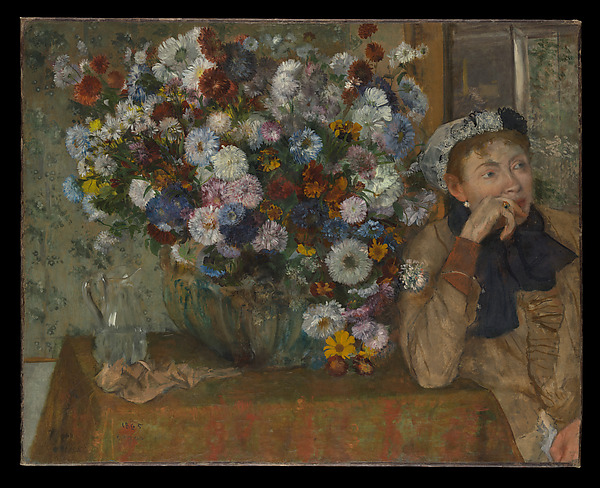
A Woman Seated beside a Vase of Flowers (Madame Paul Valpinçon?)
✦ Read about this
The most striking feature of this 1865 painting is its composition: the vase of flowers dominates the center of the canvas while the woman is pushed off to the right edge, partly cut off by the frame. This unconventional arrangement—giving the sitter a marginal, almost incidental position within her own portrait—reflects Degas's interest in unexpected croppings and asymmetry.
Edgar Degas (1834–1917) was born and died in Paris and is best known for his oil paintings and pastels, often associated with Impressionism. He painted this work when he was about thirty. The identity of the seated woman is not certain; she may be Madame Paul Valpinçon, connected to a family Degas knew.
The oil on canvas measures roughly 74 by 93 cm. It entered The Met as part of the H. O. Havemeyer Collection, bequeathed by Mrs. H. O. Havemeyer in 1929, and is held in the European Paintings department.
Background drawn from The Met & Wikipedia
Today's poem
I Wandered Lonely As a Cloud
I wandered lonely as a cloud That floats on high o'er vales and hills, When all at once I saw a crowd, A host, of golden daffodils; Beside the lake, beneath the trees, Fluttering and dancing in the breeze. Continuous as the stars that shine And twinkle on the milky way, They stretched in never-ending line Along the margin of a bay: Ten thousand saw I at a glance, Tossing their heads in sprightly dance. The waves beside them danced, but they Out-did the sparkling leaves in glee; A poet could not be but gay, In such a jocund company! I gazed—and gazed—but little thought What wealth the show to me had brought: For oft, when on my couch I lie In vacant or in pensive mood, They flash upon that inward eye Which is the bliss of solitude; And then my heart with pleasure fills, And dances with the daffodils.
William Wordsworth · Public domain
✦ Read about this
William Wordsworth helped launch the Romantic Age in English literature, publishing the landmark collection *Lyrical Ballads* (1798) jointly with Samuel Taylor Coleridge. As an English Romantic poet, he is central to the movement's emphasis on nature and personal feeling.
"I Wandered Lonely as a Cloud" is written in four six-line stanzas of rhymed iambic tetrameter. It describes the speaker's chance encounter with a large expanse of daffodils by a lake, their movement compared to stars along the Milky Way and to dancing.
The poem turns on memory: the final stanza shifts from the original sight to its later recollection. When the speaker lies "in vacant or in pensive mood," the daffodils return to "that inward eye which is the bliss of solitude," restoring the pleasure of the moment. This concern with how remembered experience nourishes the mind is characteristic of Wordsworth's poetry.
Background drawn from PoetryDB & Wikipedia