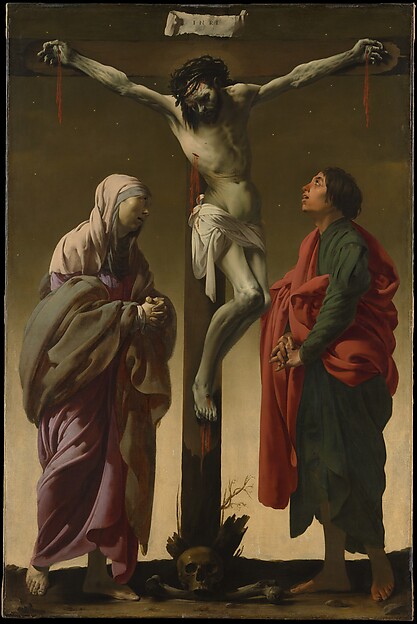
The Crucifixion with the Virgin and Saint John
✦ Read about this
Hendrick ter Brugghen painted this Crucifixion around 1624–25, likely for a clandestine Catholic church in the Protestant-dominated Dutch Republic, where public Catholic worship was banned. The subject and its devotional intensity reflect that hidden context.
Ter Brugghen (1588–1629) was one of the Utrecht Caravaggisti, the group of Dutch painters who absorbed the dramatic lighting and unidealized realism of Caravaggio, whose work Ter Brugghen would have encountered during time in Italy. Alongside Gerrit van Honthorst and Dirck van Baburen, he was among the most significant Dutch artists to carry that influence north.
The large oil on canvas, roughly 155 by 102 cm, shows Christ flanked by the mourning Virgin and Saint John. The starkly modeled bodies and archaizing, almost Northern Gothic mood set the picture apart from the smoother religious painting of the period. It entered the Met in 1956 through funds from various donors.
Background drawn from The Met & Wikipedia
Today's poem
Which is the best -- the Moon or the Crescent?
Which is the best -- the Moon or the Crescent? Neither -- said the Moon -- That is best which is not -- Achieve it -- You efface the Sheen. Not of detention is Fruition -- Shudder to attain. Transport's decomposition follows -- He is Prism born.
Emily Dickinson · Public domain
✦ Read about this
Emily Dickinson published almost nothing during her lifetime and was largely unknown as a poet while she lived; her work is now regarded as canonical. The Poetry Foundation describes her as having "created in her writing a distinctively elliptical language for expressing what was possible but not yet realized" — a description that fits this poem's compressed, paradoxical manner.
The poem stages a small dialogue: the Moon, asked whether it or the crescent is better, answers "Neither," insisting that "That is best which is not." Achieving something, it warns, "You efface the Sheen." The argument turns on anticipation versus attainment — fruition brings not fulfillment but "Transport's decomposition."
Formally it is brief and elliptical, built from Dickinson's characteristic dashes, capitalized abstractions, and clipped syntax. Its subject is the value of the unrealized: desire and possibility are preferable to their fulfillment, since attainment dissolves the very radiance the crescent promised.
Background drawn from PoetryDB & Wikipedia