The Plan
✦ Read about this
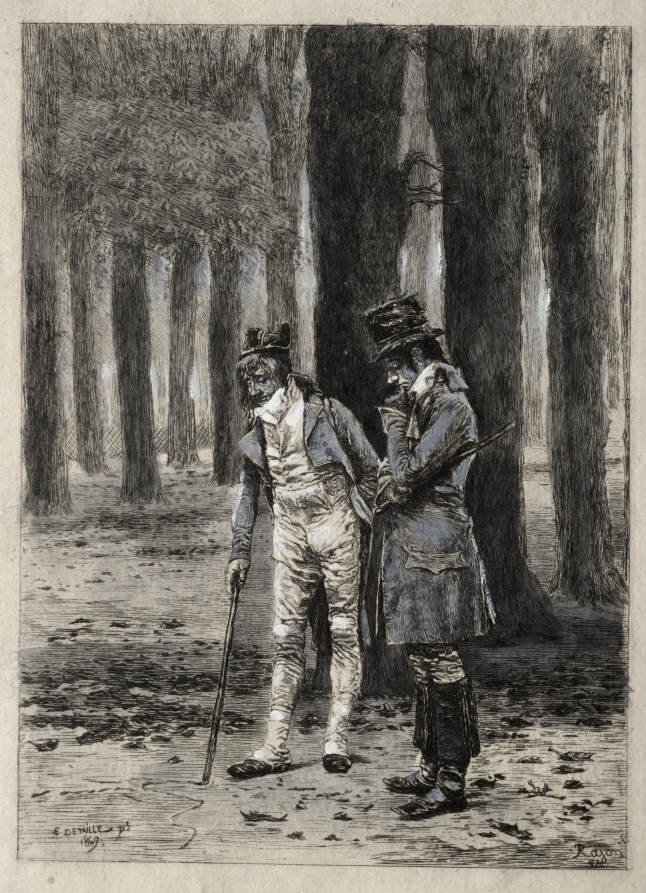
"The Plan" is not an original composition by Paul Rajon but an etching he made after a painting by Édouard Detaille, a fellow French artist known for military subjects. Rajon produced the print in 1870, using etching with white heightening to add tonal accents to the image.
Rajon (French, 1842/43–1888) worked as both a painter and printmaker, though he began his career in photography. Reproductive etchings like this one were a common way to circulate the compositions of admired painters in the nineteenth century.
The impression at the Cleveland Museum of Art came as a gift from Frederick Keppel and Co., Inc., part of the Frederick Keppel Memorial, in 1918.
Background drawn from Cleveland Museum of Art & Wikipedia
Today's poem
Is it Well with the Child?
SAFE where I cannot die yet, Safe where I hope to lie too, Safe from the fume and the fret; You, and you, Whom I never forget. Safe from the frost and the snow, Safe from the storm and the sun, Safe where the seeds wait to grow One by one, And to come back in blow.
Christina Rossetti · Public domain
✦ Read about this
Christina Rossetti (1830–1894, though dates are not among the facts given here) was an English writer of romantic and devotional poems, best known for "Goblin Market" and "Remember." Her devotional strain, evident throughout her work, shapes this short lyric.
"Is it Well with the Child?" is a brief meditation on death and burial, its title drawn from the biblical exchange in 2 Kings. The poem repeats "Safe" as an anchor, insisting that the dead are protected—"from the fume and the fret," "from the frost and the snow," "from the storm and the sun." The consolation is both spiritual and natural: the buried lie "where the seeds wait to grow," a promise of return "in blow," or blossom.
The two five-line stanzas are compact and heavily patterned, using short lines and internal echoes. The speaker addresses the dead directly—"You, and you, / Whom I never forget"—turning the poem into an act of remembrance.
Background drawn from PoetryDB & Wikipedia