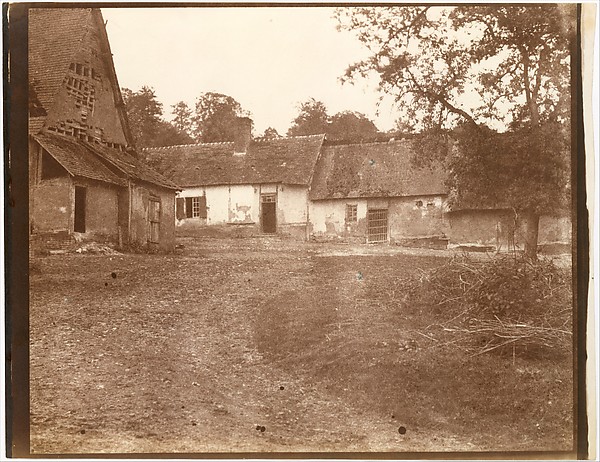
Romesnil
✦ Read about this
Louis-Rémy Robert (1810–1882) worked for most of his career at the Sèvres porcelain manufactory, where he directed the painting and gilding workshops before turning to photography in the early 1850s—a chemist's and colorist's eye applied to a new medium. His technical background suited the exacting processes of early paper photography.
This view, titled "Romesnil," was made between 1850 and 1855 as a salted paper print from a paper negative. The salt-print process yielded soft, matte images with broad tonal gradations, while the paper negative gave results a diffused, textured character distinct from later glass-plate methods.
The print, measuring 27 by 35.2 cm, entered the Metropolitan Museum of Art in 1996 through purchase with funds from the Joseph Pulitzer Bequest.
Background drawn from The Met
Today's poem
This Moment, Yearning and Thoughtful.
THIS moment yearning and thoughtful, sitting alone, It seems to me there are other men in other lands, yearning and thoughtful; It seems to me I can look over and behold them, in Germany, Italy, France, Spain—or far, far away, in China, or in Russia or India—talking other dialects; And it seems to me if I could know those men, I should become attached to them, as I do to men in my own lands; O I know we should be brethren and lovers, I know I should be happy with them.
Walt Whitman · Public domain
✦ Read about this
Walt Whitman, often called the father of free verse, was an American poet, essayist, and journalist considered among the most influential writers in American and world literature. He blended transcendentalism and realism, and his 1855 collection Leaves of Grass drew controversy in its day, condemned by some as obscene for its overt sensuality.
This short poem exemplifies the free verse Whitman pioneered, its long, unmetered lines unfolding in a single sustained thought. The speaker, sitting alone, imagines men in Germany, Italy, France, Spain, China, Russia, and India—people speaking other dialects whom he will never meet.
Its subject is a sense of fellow feeling that crosses national and linguistic boundaries. Whitman asserts that, could he know these distant men, he would become attached to them as to those in his own country, declaring they "should be brethren and lovers." The poem extends his recurring theme of affectionate human connection to a global scale.
Background drawn from PoetryDB & Wikipedia