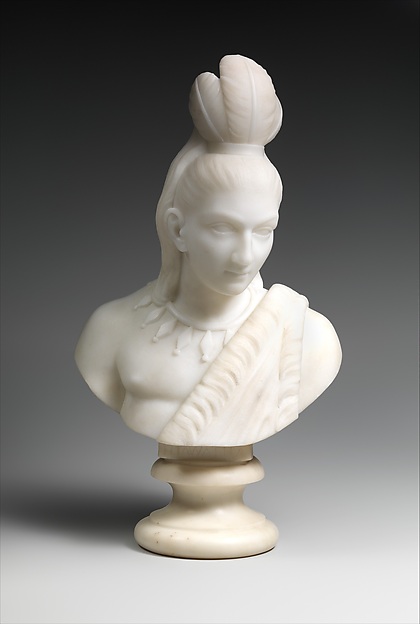
Hiawatha
✦ Read about this
Edmonia Lewis, of mixed African-American and Native American heritage, was the first sculptor of color to gain international recognition. Born in Upstate New York in 1844, she moved to Rome in 1866 and worked there for most of her career, joining the community of American expatriate sculptors then active in the city.
This marble bust of 1868 depicts Hiawatha, a subject Lewis drew from Henry Wadsworth Longfellow's popular narrative poem *The Song of Hiawatha*. The choice reflects both the vogue for Longfellow among Rome's American colony and Lewis's own engagement with Native American subject matter.
Carved in the neoclassical idiom favored by her circle, the bust measures under fourteen inches high. The Metropolitan Museum acquired it in 2015 with the Morris K. Jesup and Friends of the American Wing Funds.
Background drawn from The Met & Wikipedia
Today's poem
Beautiful Women.
WOMEN sit, or move to and fro—some old, some young; The young are beautiful—but the old are more beautiful than the young.
Walt Whitman · Public domain
✦ Read about this
Walt Whitman, often called the father of free verse, remains one of the most influential poets in American and world literature. He worked as an essayist and journalist and wrote two novels, but his reputation rests on his poetry, which blended transcendentalism and realism. His 1855 collection Leaves of Grass drew controversy in his time, with some critics calling it obscene for its overt sensuality.
"Beautiful Women" is a compressed two-line poem observing women of different ages in motion and repose. Its central move is a reversal of the expected: the young are beautiful, but the old are declared more beautiful still.
The poem's brevity is notable against Whitman's better-known expansive, cataloguing style. In a few words it registers his characteristic attention to ordinary human bodies and his refusal to equate beauty solely with youth.
Background drawn from PoetryDB & Wikipedia