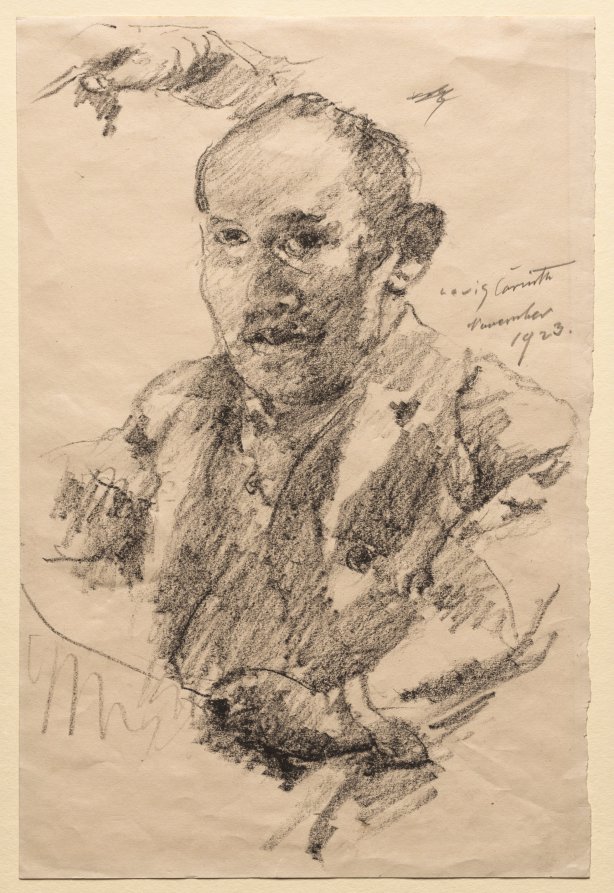
Self-Portrait
✦ Read about this
Lovis Corinth (1858–1925) drew this self-portrait in 1923, two years before his death and roughly a decade after a stroke in 1911 that altered his working methods and the character of his art. Portraits of himself were a recurring subject throughout his career.
The drawing is executed in black crayon—likely Conté—on a sheet measuring about 50 by 34 centimeters. A German painter, printmaker, and writer, Corinth is known for work that combined the loose brushwork and light of Impressionism with the emotional intensity of Expressionism.
The sheet belongs to the Mr. and Mrs. Charles G. Prasse Collection at the Cleveland Museum of Art, acquired in 1969.
Background drawn from Cleveland Museum of Art & Wikipedia
Today's poem
The Chimney Sweeper
A little black thing in the snow, Crying "weep! weep!" in notes of woe! "Where are thy father and mother? Say!"-- "They are both gone up to the church to pray. "Because I was happy upon the heath, And smiled among the winter's snow, They clothed me in the clothes of death, And taught me to sing the notes of woe. "And because I am happy and dance and sing, They think they have done me no injury, And are gone to praise God and his priest and king, Who make up a heaven of our misery."
William Blake · Public domain
✦ Read about this
William Blake was an English poet, painter and printmaker who was largely unrecognised in his lifetime but is now regarded as a seminal figure of the Romantic Age. He lived in London for almost all his life, apart from three years in Felpham, and produced a symbolically rich body of work that treated the imagination as, in his words, "the body of God" or "human existence itself."
"The Chimney Sweeper" takes the form of a short dialogue: a passerby questions a soot-blackened child crying in the snow, and the child answers. The poem's directness and its bitter irony carry its argument.
The child explains that his parents have gone to church while he suffers, and lays blame on "God and his priest and king." The poem is an indictment of the religious and social institutions that permit child labour and rationalise a child's misery as no injury done.
Background drawn from PoetryDB & Wikipedia