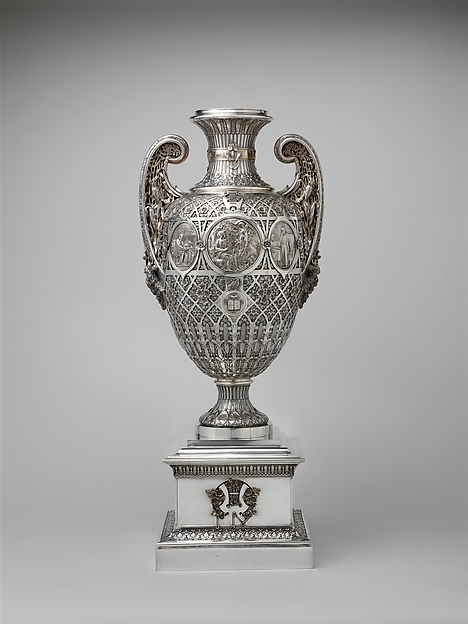
The Bryant Vase
✦ Read about this
The Bryant Vase was made by Tiffany & Co. in 1876 to honor the American poet and newspaper editor William Cullen Bryant, whose name it bears. Bryant himself donated the vase to the Metropolitan Museum of Art the following year, in 1877, placing the tribute object in a public collection almost immediately after its creation.
Standing over 33 inches tall and worked in silver and gold, the vase weighs nearly 453 troy ounces—more than 14 kilograms of precious metal. It was produced in New York by Tiffany & Co., the firm founded in 1837 and long recognized for its silverwork.
The vase belongs to the Met's American Wing and reflects the ambitious presentation silver being made in the United States around the time of the nation's centennial in 1876.
Background drawn from The Met & Wikipedia
Today's poem
I Wandered Lonely As A Cloud
I wandered lonely as a cloud That floats on high o'er vales and hills, When all at once I saw a crowd, A host, of golden daffodils; Beside the lake, beneath the trees, Fluttering and dancing in the breeze. Continuous as the stars that shine And twinkle on the milky way, They stretched in never-ending line Along the margin of a bay: Ten thousand saw I at a glance, Tossing their heads in sprightly dance. The waves beside them danced, but they Out-did the sparkling leaves in glee; A poet could not be but gay, In such a jocund company! I gazed—and gazed—but little thought What wealth the show to me had brought: For oft, when on my couch I lie In vacant or in pensive mood, They flash upon that inward eye Which is the bliss of solitude; And then my heart with pleasure fills, And dances with the daffodils.
William Wordsworth · Public domain
✦ Read about this
William Wordsworth helped launch the Romantic Age in English literature, publishing the landmark collection *Lyrical Ballads* (1798) jointly with Samuel Taylor Coleridge. As an English Romantic poet, his work characteristically drew on the natural world and on memory as sources of feeling.
"I Wandered Lonely As A Cloud" is among his best-known poems, built from four six-line stanzas in regular rhyme and meter. It describes the speaker coming upon a large expanse of daffodils by a lake, comparing them to stars and dwelling on their motion in the breeze.
The poem turns on memory: the final stanza shifts from the scene itself to its later recall, when the daffodils "flash upon that inward eye" during quiet or reflective moments and renew the speaker's pleasure. This emphasis on recollected experience as a lasting emotional resource is central to Wordsworth's Romantic outlook.
Background drawn from PoetryDB & Wikipedia