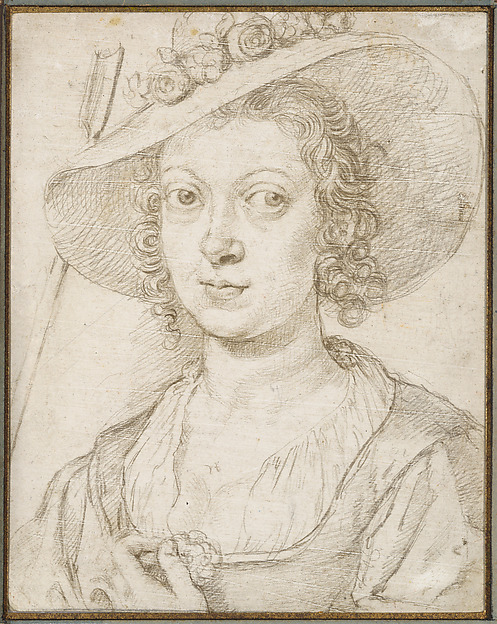
Portrait of a woman as a shepherdess
✦ Read about this
This small portrait was made in metalpoint — a demanding technique in which the artist draws with a metal stylus on a specially prepared surface, here a piece of parchment known as a tafelet. By the mid-seventeenth century metalpoint was largely obsolete, replaced by graphite and chalk, which makes de Passe's use of it around 1635–40 unusual. The sheet is tiny, roughly 8.5 by 6.8 centimeters.
Crispijn de Passe the Younger (ca. 1594–1670) was a Dutch Golden Age engraver, draughtsman and print publisher, and a member of the prolific Van de Passe printmaking family; his father, Crispijn the Elder, was also an engraver and publisher.
The sitter is shown in the guise of a shepherdess, a fashionable pastoral conceit in Dutch portraiture of the period. The drawing was later set into a painted mount made in the nineteenth century. It entered the Met in 2024.
Background drawn from The Met & Wikipedia
Today's poem
An Enigma
"Seldom we find," says Solomon Don Dunce, "Half an idea in the profoundest sonnet. Through all the flimsy things we see at once As easily as through a Naples bonnet-- Trash of all trash!--how _can_ a lady don it? Yet heavier far than your Petrarchan stuff-- Owl-downy nonsense that the faintest puff Twirls into trunk-paper the while you con it." And, veritably, Sol is right enough. The general tuckermanities are arrant Bubbles--ephemeral and _so_ transparent-- But _this is_, now--you may depend upon it-- Stable, opaque, immortal--all by dint Of the dear names that lie concealed within't.
Edgar Allan Poe · Public domain
✦ Read about this
Edgar Allan Poe, best known for his tales of mystery and the macabre, was one of the central figures of American Romanticism and Gothic fiction. Though his reputation rests largely on poems and stories of dread, "An Enigma" shows a lighter, wittier side.
The poem is a sonnet that mocks sonnets. It opens with a comic authority, "Solomon Don Dunce," complaining that most sonnets contain barely half an idea, comparing Petrarchan verse to flimsy nonsense that a puff of air could blow away. Poe then turns the joke on its head, claiming his own poem is "stable, opaque, immortal."
The claim points to the poem's title: it is a puzzle. Hidden within the lines are "dear names" spelled out by a coded pattern of letters. The word "tuckermanities" alludes to the writer Henry Theodore Tuckerman, adding a satirical jab at contemporary literary fashion.
Background drawn from PoetryDB & Wikipedia