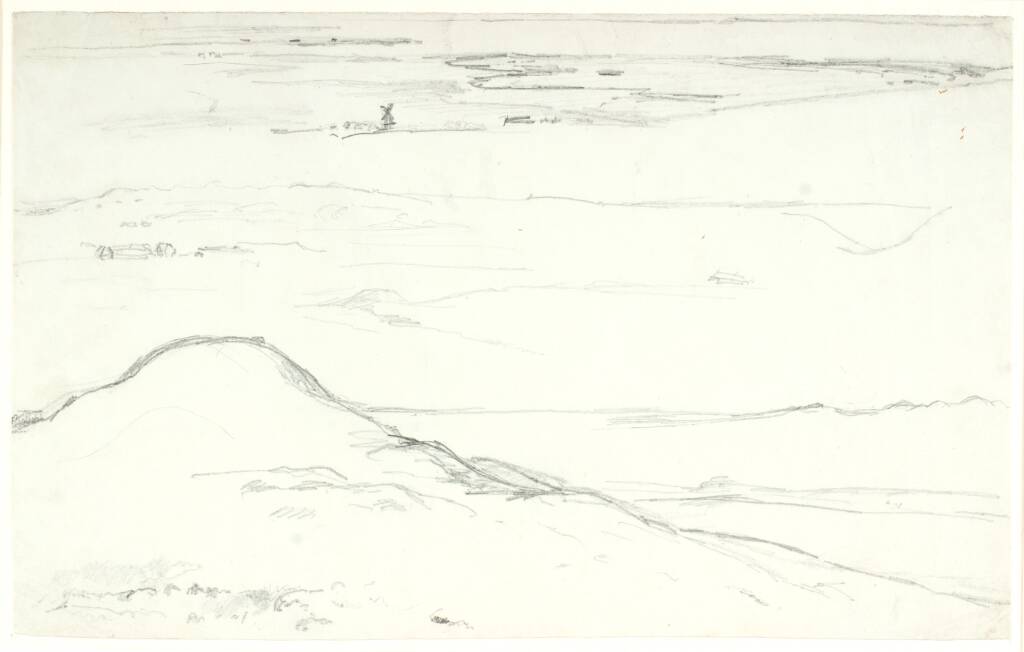
Klitparti ved Bavnehøj
✦ Read about this
"Klitparti ved Bavnehøj" is a pencil drawing made in 1843 by Dankvart Dreyer, a Danish landscape artist trained under Christoffer Wilhelm Eckersberg, the central teacher of the Copenhagen School.
Around 1840 Dreyer worked within the emerging National Romantic movement in Danish landscape painting, but his dramatic and unusually naturalistic approach clashed with the aesthetic and ideological expectations of the period. Widely criticized, he withdrew from the artistic establishment and fell into near obscurity. He died of typhus in 1852, aged 36.
The drawing, executed in pencil, depicts a section of dunes near Bavnehøj. It is held in the collection of the SMK — National Gallery of Denmark.
Background drawn from SMK — National Gallery of Denmark & Wikipedia
Today's poem
Written On A Summer Evening
The church bells toll a melancholy round, Calling the people to some other prayers, Some other gloominess, more dreadful cares, More harkening to the sermon's horrid sound. Surely the mind of man is closely bound In some blind spell: seeing that each one tears Himself from fireside joys and Lydian airs, And converse high of those with glory crowned. Still, still they toll, and I should feel a damp, A chill as from a tomb, did I not know That they are dying like an outburnt lamp,— That 'tis their sighing, wailing, ere they go Into oblivion—that fresh flowers will grow, And many glories of immortal stamp.
John Keats · Public domain
✦ Read about this
John Keats was an English poet of the second generation of Romantics, alongside Byron and Shelley. His poems had been in publication for less than four years when he died of tuberculosis at 25. They were indifferently received in his lifetime, but his reputation grew rapidly after his death; by the end of the nineteenth century he was firmly established in the canon of English literature and a strong influence on the Pre-Raphaelite Brotherhood.
"Written On A Summer Evening" is a sonnet built around the sound of church bells calling people to prayer. Keats treats the summons with hostility, casting formal religion as a "blind spell" that draws people away from domestic warmth, music ("Lydian airs"), and cultivated conversation.
The closing sestet turns on the image of the bells themselves fading like "an outburnt lamp." Their tolling is heard as the dying sound of a religion passing into oblivion, to be replaced by "fresh flowers" and "many glories of immortal stamp."
Background drawn from PoetryDB & Wikipedia