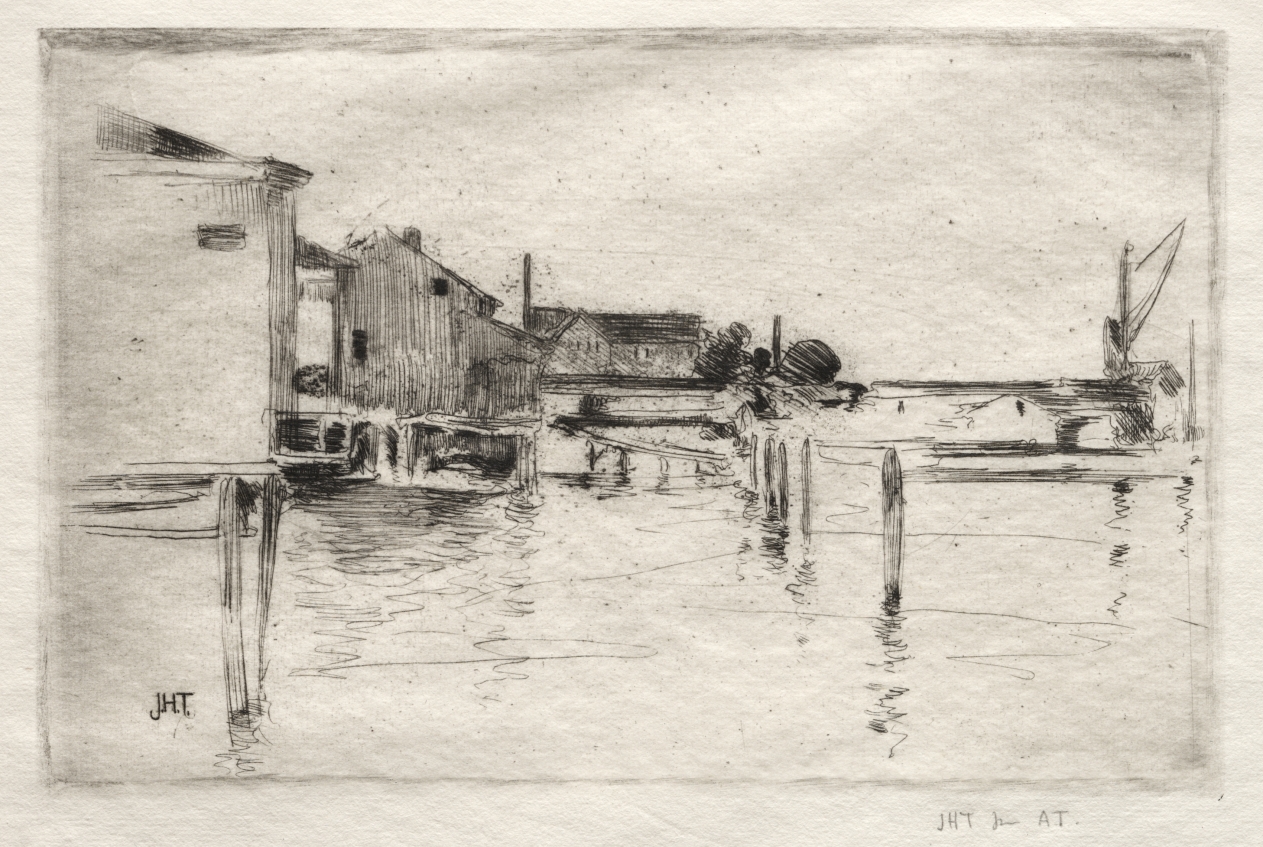
The Dock, Bridgeport, Connecticut
✦ Read about this
John Henry Twachtman (1853–1902) is best known for landscape paintings, but this etching from around 1889 documents an industrial waterfront subject: a dock at Bridgeport, Connecticut. Etching allowed him to work in a linear, tonal medium distinct from the atmospheric handling of his painted work.
Twachtman was among the more personal and experimental of the American Impressionists. In 1898 he became a member of "The Ten," a group of American artists who withdrew from established professional art organizations to exhibit together as a stylistically coherent group.
The print entered the Cleveland Museum of Art in 1969 as a gift from Mr. and Mrs. Martin Lerner, given in memory of Samuel L. Rubenstein.
Background drawn from Cleveland Museum of Art & Wikipedia
Today's poem
Moonrise
I awoke in the Midsummer not to call night, in the white and the walk of the morning: The moon, dwindled and thinned to the fringe of a finger-nail held to the candle, Or paring of paradisaical fruit, lovely in waning but lustreless, Stepped from the stool, drew back from the barrow, of dark Maenefa the mountain; A cusp still clasped him, a fluke yet fanged him, entangled him, not quite utterly. This was the prized, the desirable sight, unsought, presented so easily, Parted me leaf and leaf, divided me, eyelid and eyelid of slumber.
Gerard Manley Hopkins · Public domain
✦ Read about this
Gerard Manley Hopkins (1844–1889) was an English poet and Jesuit priest whose work was little known while he lived but later established him as a major innovator. He is best remembered for sprung rhythm, a metrical system built on stressed syllables, and for a densely textured verse that praises God through close observation of nature.
"Moonrise" is a fragment recording a specific moment: waking at midsummer near dawn to see the thin waning moon rising over Maenefa, a mountain near Tremeirchion in Wales. The poem tracks the moon appearing to detach itself from the mountain's edge, "a cusp still clasped him, a fluke yet fanged him," still partly caught by the ridge.
The lines show Hopkins's characteristic features: heavy alliteration, compressed compound phrasing, and long, stress-driven rhythms. The imagery is precise and unexpected—the moon likened to a fingernail paring held to a candle, or to "paring of paradisaical fruit"—and the sight rouses the speaker fully from sleep.
Background drawn from PoetryDB & Wikipedia