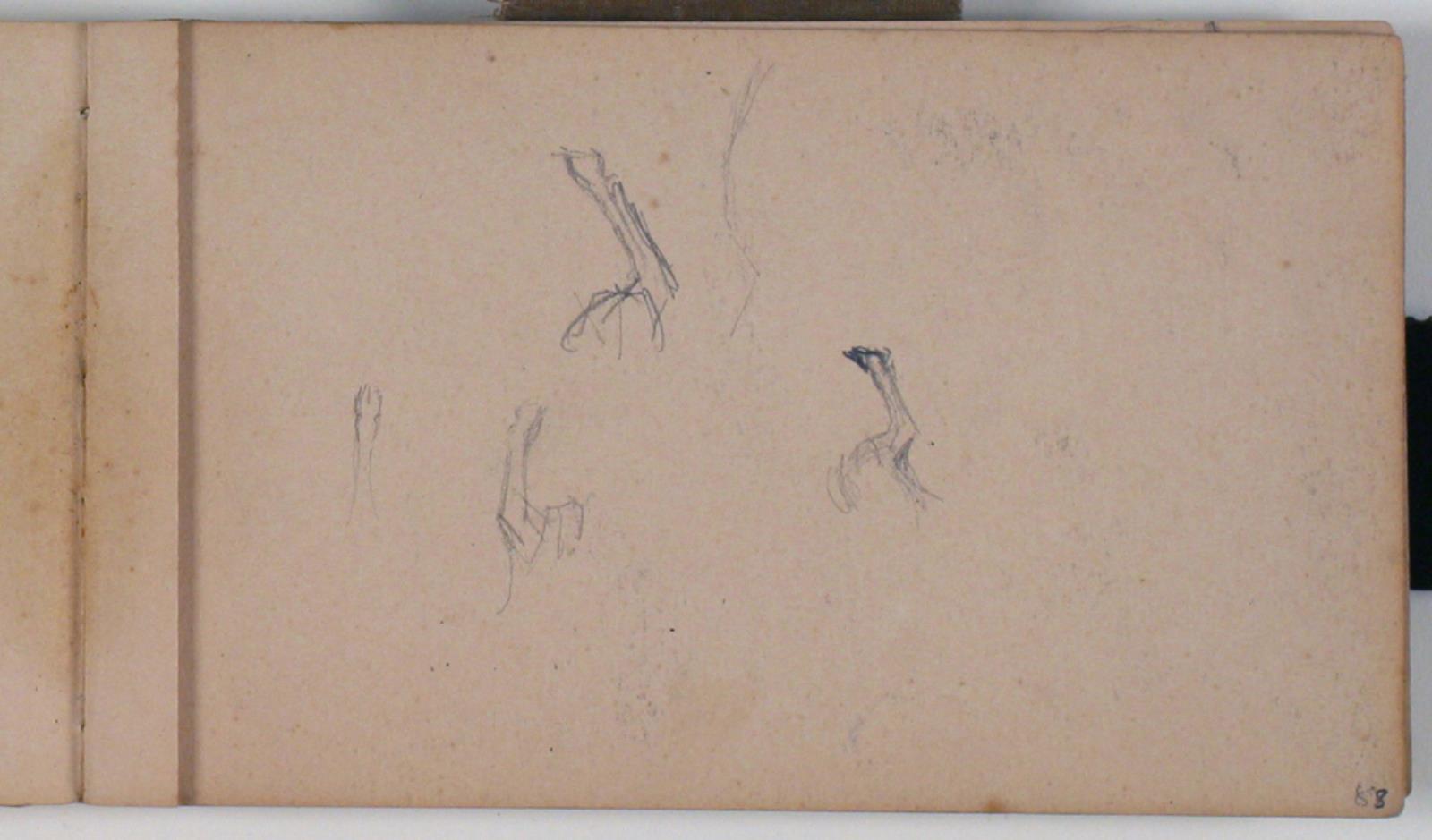
Studier af et klovdyrs bagben
✦ Read about this
This 1896 pencil drawing by Niels Larsen Stevns (1857–1933) studies the hind leg of a cloven-hoofed animal—an anatomical exercise of the kind that underpinned his later figurative and decorative work.
Larsen Stevns came to fine art by an unusual route. He first trained as a journeyman painter before enrolling at the Kunstakademiet in Copenhagen, attending in 1886–1887 and again in 1892–1894. He is best known for assisting Joakim Skovgaard on the decoration of Viborg Cathedral, working in a simplified style drawn from early Christian and Byzantine art.
The sheet is held by the SMK — National Gallery of Denmark.
Background drawn from SMK — National Gallery of Denmark & Wikipedia
Today's poem
The Road Not Taken
Two roads diverged in a yellow wood, And sorry I could not travel both And be one traveler, long I stood And looked down one as far as I could To where it bent in the undergrowth; Then took the other, as just as fair, And having perhaps the better claim, Because it was grassy and wanted wear; Though as for that the passing there Had worn them really about the same,
Robert Frost · 1916 · Public domain
✦ Read about this
Robert Frost (Robert Lee Frost) was an American poet known for realistic depictions of rural life and his command of American colloquial speech. He frequently drew on settings from rural New England in the early 20th century, using them to examine complex social and philosophical themes.
"The Road Not Taken" is characteristic of that approach: it takes a plain scene — a walker choosing between two paths in an autumn wood — and turns it toward larger questions about choice and its consequences. The speaker studies both roads and takes one, though he acknowledges the two are worn "really about the same," complicating any simple reading of the poem as a straightforward endorsement of individualism.
The poem is written in measured, conversational stanzas, its regular form matched to the everyday diction Frost favored. The tension between the deliberate weight the speaker gives his decision and his admission that the paths differed little is central to the poem's effect.
Background drawn from curated & Wikipedia