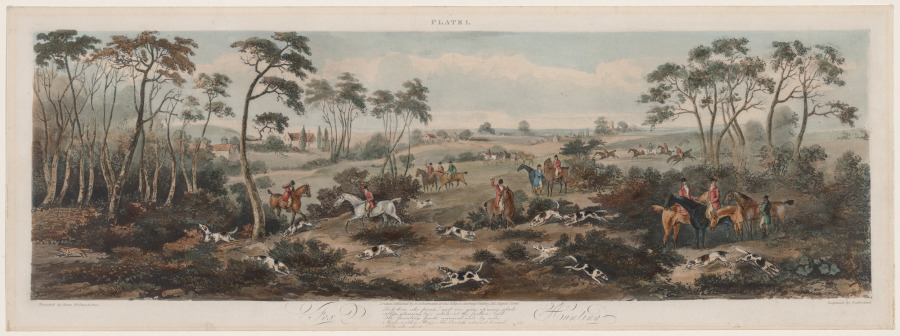
Fox Hunting, No. 1
✦ Read about this
Thomas Sutherland (1785–1838) was a British engraver known primarily for maritime and naval subjects, working in aquatint and etching—a combination well suited to reproducing the tonal range and detail of painted originals.
This print, *Fox Hunting, No. 1*, belongs to the sporting-print tradition, a popular genre in early nineteenth-century Britain that documented and celebrated field pursuits such as hunting and racing. Aquatint, which produces broad areas of even tone, was the standard technique for such plates, often combined with etched line for finer detail.
The impression at the Cleveland Museum of Art came from the bequest of James Parmelee in 1940.
Background drawn from Cleveland Museum of Art & Wikipedia
Today's poem
Out of the Rolling Ocean, the Crowd.
1 OUT of the rolling ocean, the crowd, came a drop gently to me, Whispering, I love you, before long I die, I have travel’d a long way, merely to look on you, to touch you, For I could not die till I once look’d on you, For I fear’d I might afterward lose you. 2 (Now we have met, we have look’d, we are safe; Return in peace to the ocean, my love; I too am part of that ocean, my love—we are not so much separated; Behold the great rondure—the cohesion of all, how perfect! But as for me, for you, the irresistible sea is to separate us, As for an hour, carrying us diverse—yet cannot carry us diverse for ever; Be not impatient—a little space—Know you, I salute the air, the ocean and the land, Every day, at sundown, for your dear sake, my love.)
Walt Whitman · Public domain
✦ Read about this
Walt Whitman (1819–1892) was an American poet, essayist, and journalist, often called the father of free verse and considered one of the most influential poets in American and world literature. He blended transcendentalism and realism, and his work was controversial in his time; his 1855 collection Leaves of Grass was described by some as obscene for its overt sensuality.
"Out of the Rolling Ocean, the Crowd" is written in Whitman's characteristic free verse, with long, cadenced lines and no fixed rhyme or meter. The poem stages an encounter between lovers figured as a single drop rising from the ocean of the anonymous crowd.
Its central image extends the meeting into a meditation on separation and unity: the sea that will carry the lovers apart is also the whole of which both are parts, so that division is temporary. The speaker closes with a daily vow to salute the air, ocean, and land at sundown for the beloved's sake.
Background drawn from PoetryDB & Wikipedia