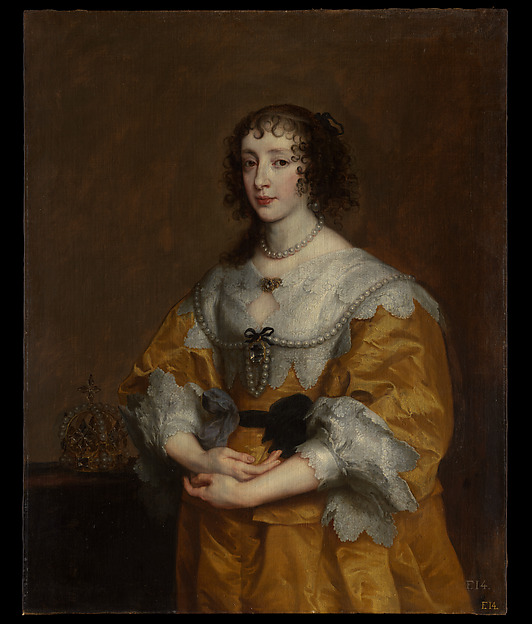
Queen Henrietta Maria
✦ Read about this
Anthony van Dyck painted this portrait of Queen Henrietta Maria, wife of Charles I of England, in 1636, during his years as the leading court painter in England. Born in Antwerp in 1599, the Flemish artist had already built a reputation in the Spanish Netherlands and Italy before settling in London, where his elegant, fluid style shaped English portraiture for generations.
The oil on canvas measures roughly 106 by 85 centimeters. Van Dyck produced numerous portraits of the queen and the royal family, images that defined the visual identity of the Caroline court.
The painting entered the Metropolitan Museum of Art in 2019 as a bequest of Mrs. Charles Wrightsman, in honor of Annette de la Renta.
Background drawn from The Met & Wikipedia
Today's poem
Lines Written In Early Spring
I heard a thousand blended notes, While in a grove I sate reclined, In that sweet mood when pleasant thoughts Bring sad thoughts to the mind. To her fair works did Nature link The human soul that through me ran; And much it grieved my heart to think What man has made of man. Through primrose tufts, in that green bower, The periwinkle trailed its wreaths; And 'tis my faith that every flower Enjoys the air it breathes. The birds around me hopped and played, Their thoughts I cannot measure:-- But the least motion which they made It seemed a thrill of pleasure. The budding twigs spread out their fan, To catch the breezy air; And I must think, do all I can, That there was pleasure there. If this belief from heaven be sent, If such be Nature's holy plan, Have I not reason to lament What man has made of man?
William Wordsworth · Public domain
✦ Read about this
William Wordsworth was an English Romantic poet who, with Samuel Taylor Coleridge, helped launch the Romantic Age in English literature through their joint publication Lyrical Ballads (1798). "Lines Written in Early Spring" appeared in that collection.
The poem is built from six four-line stanzas, using the plain diction and everyday scene characteristic of the Lyrical Ballads project. A speaker sits reclined in a grove, listening to birdsong and observing primroses, periwinkle, and budding twigs.
Its subject is the contrast between the apparent pleasure of the natural world and human failing. Wordsworth links the natural world to a benign design—"Nature's holy plan"—and imagines that flowers, birds, and twigs each take joy in existence. Against this, the recurring line "What man has made of man" registers a grief that shadows the poem's pleasant mood, turning observation into a lament for human cruelty and disappointment.
Background drawn from PoetryDB & Wikipedia