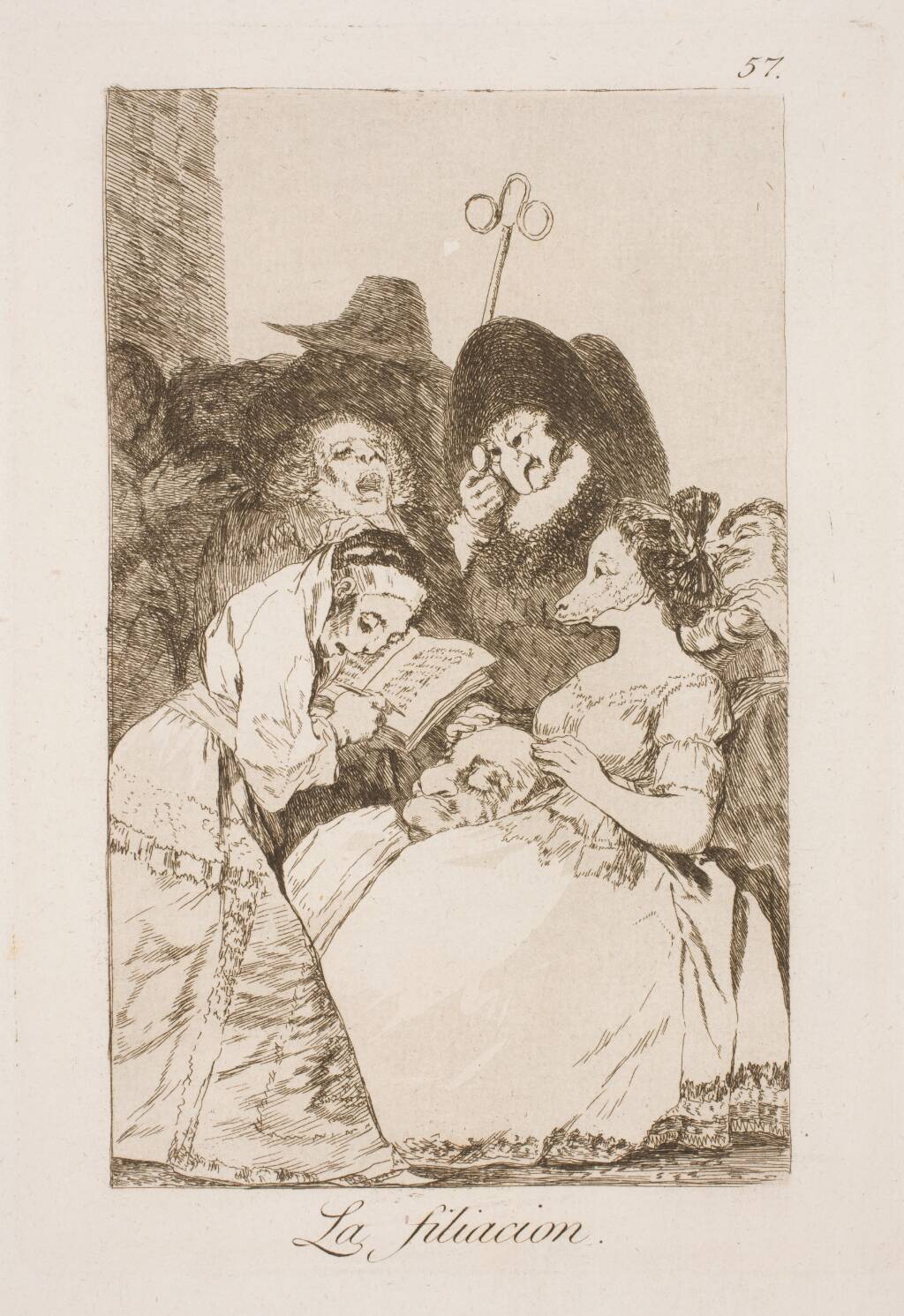
Stamtræet
✦ Read about this
"Stamtræet" (The Family Tree) is an etching Goya made in 1797–1798, part of the series of prints known as the Los Caprichos, produced during a period when he turned from court portraiture toward biting social satire.
Goya (1746–1828) was the leading Spanish artist of the late 18th and early 19th centuries. Working across painting, drawing, and printmaking, he responded directly to the political and social upheavals of his time. He is frequently described as the last of the Old Masters and the first of the moderns, and his work shaped later 19th- and 20th-century painting.
The print was made using etching, a technique in which lines are bitten into a metal plate with acid before printing. This impression is held by the SMK — National Gallery of Denmark.
Background drawn from SMK — National Gallery of Denmark & Wikipedia
Today's poem
I Wandered Lonely As A Cloud
I wandered lonely as a cloud That floats on high o'er vales and hills, When all at once I saw a crowd, A host, of golden daffodils; Beside the lake, beneath the trees, Fluttering and dancing in the breeze. Continuous as the stars that shine And twinkle on the milky way, They stretched in never-ending line Along the margin of a bay: Ten thousand saw I at a glance, Tossing their heads in sprightly dance. The waves beside them danced, but they Out-did the sparkling leaves in glee; A poet could not be but gay, In such a jocund company! I gazed—and gazed—but little thought What wealth the show to me had brought: For oft, when on my couch I lie In vacant or in pensive mood, They flash upon that inward eye Which is the bliss of solitude; And then my heart with pleasure fills, And dances with the daffodils.
William Wordsworth · Public domain
✦ Read about this
William Wordsworth, with Samuel Taylor Coleridge, helped launch the Romantic Age in English literature through their joint publication Lyrical Ballads (1798). As one of the leading English Romantic poets, he shaped a movement that emphasized nature, emotion, and individual experience.
"I Wandered Lonely As A Cloud" is written in four six-line stanzas, each rhyming ababcc, in regular iambic tetrameter. The poem describes the speaker coming upon a large expanse of daffodils beside a lake, and the imagery of dancing and fluttering flowers recurs throughout.
The poem turns on memory: its final stanza describes how the remembered sight later returns to the speaker in solitude, filling his heart with pleasure. This movement from immediate perception to recollected emotion reflects a central concern of Wordsworth's poetry — the lasting value of experiences drawn from the natural world.
Background drawn from PoetryDB & Wikipedia