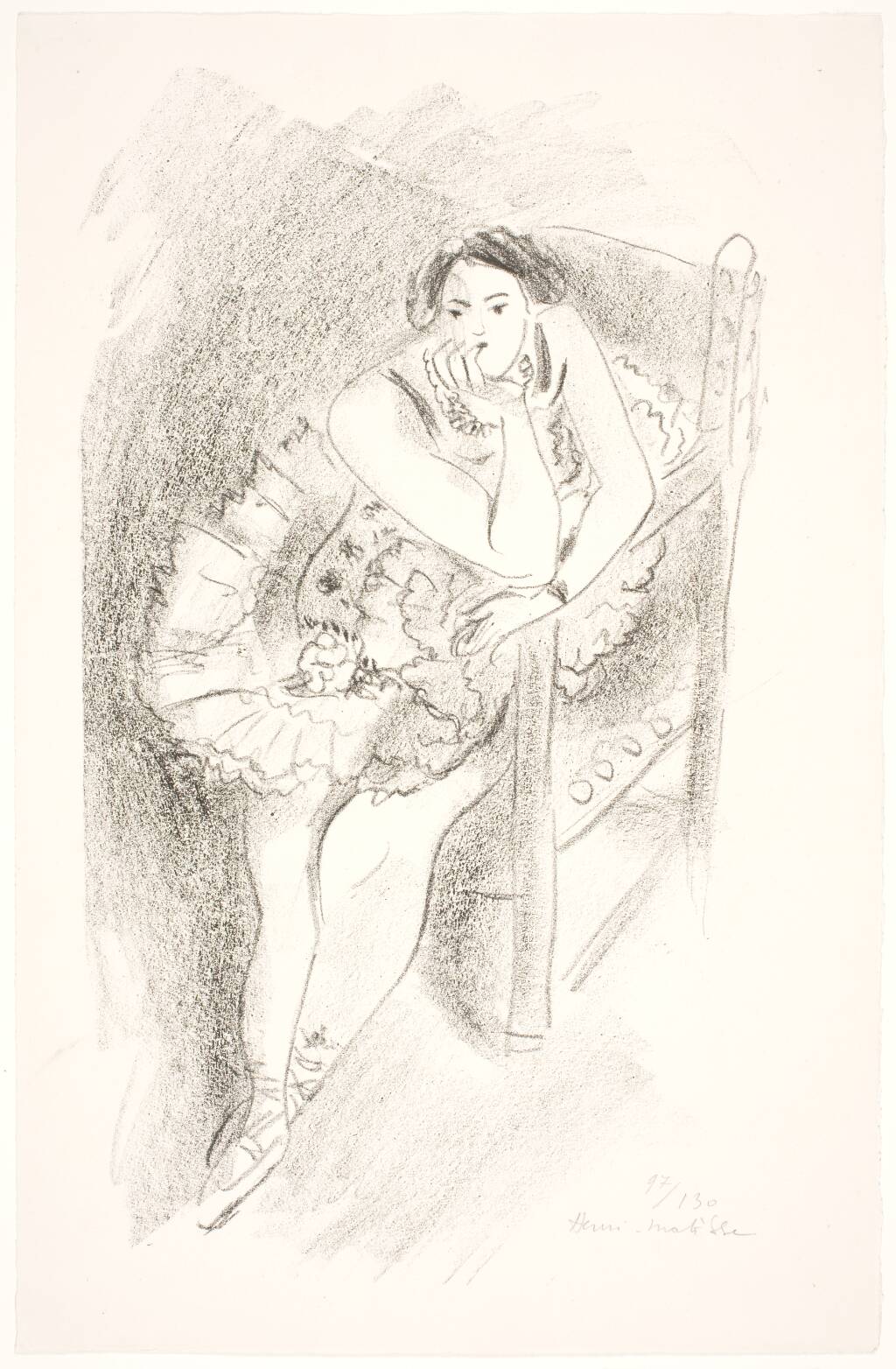
Danserinde, siddende i en stol med hovedet understøttet af sin hånd
✦ Read about this
Though celebrated primarily as a painter, Henri Matisse (1869–1954) worked extensively as a draughtsman and printmaker, and this 1927 lithograph, "Danserinde, siddende i en stol med hovedet understøttet af sin hånd" ("Dancer, seated in a chair with her head resting on her hand"), belongs to that graphic output.
The work dates from Matisse's years in Nice, when the odalisque and the seated female figure became recurring subjects across his painting and prints. Lithography allowed him to translate his fluid, economical line—one of the defining features of his draughtsmanship—directly onto the printed sheet.
The print is held in the collection of the SMK, the National Gallery of Denmark.
Background drawn from SMK — National Gallery of Denmark & Wikipedia
Today's poem
Lines Written In Early Spring
I heard a thousand blended notes, While in a grove I sate reclined, In that sweet mood when pleasant thoughts Bring sad thoughts to the mind. To her fair works did Nature link The human soul that through me ran; And much it grieved my heart to think What man has made of man. Through primrose tufts, in that green bower, The periwinkle trailed its wreaths; And 'tis my faith that every flower Enjoys the air it breathes. The birds around me hopped and played, Their thoughts I cannot measure:-- But the least motion which they made It seemed a thrill of pleasure. The budding twigs spread out their fan, To catch the breezy air; And I must think, do all I can, That there was pleasure there. If this belief from heaven be sent, If such be Nature's holy plan, Have I not reason to lament What man has made of man?
William Wordsworth · Public domain
✦ Read about this
William Wordsworth was an English Romantic poet who, with Samuel Taylor Coleridge, helped to launch the Romantic Age in English literature through their joint publication Lyrical Ballads (1798). "Lines Written in Early Spring" appeared in that volume.
The poem is built from six ballad-like quatrains in a plain, direct style. A speaker sitting reclined in a grove listens to birdsong and observes primroses, periwinkle, and budding twigs, reading pleasure into the natural world around him.
Its central movement is the contrast between the harmony of nature and human failing. The pleasant setting brings "sad thoughts," and the recurring line "What man has made of man" turns the poem toward lament. Wordsworth frames his sense that every flower and creature enjoys its existence as a "faith" and part of "Nature's holy plan," using that belief to measure the failures of human society.
Background drawn from PoetryDB & Wikipedia