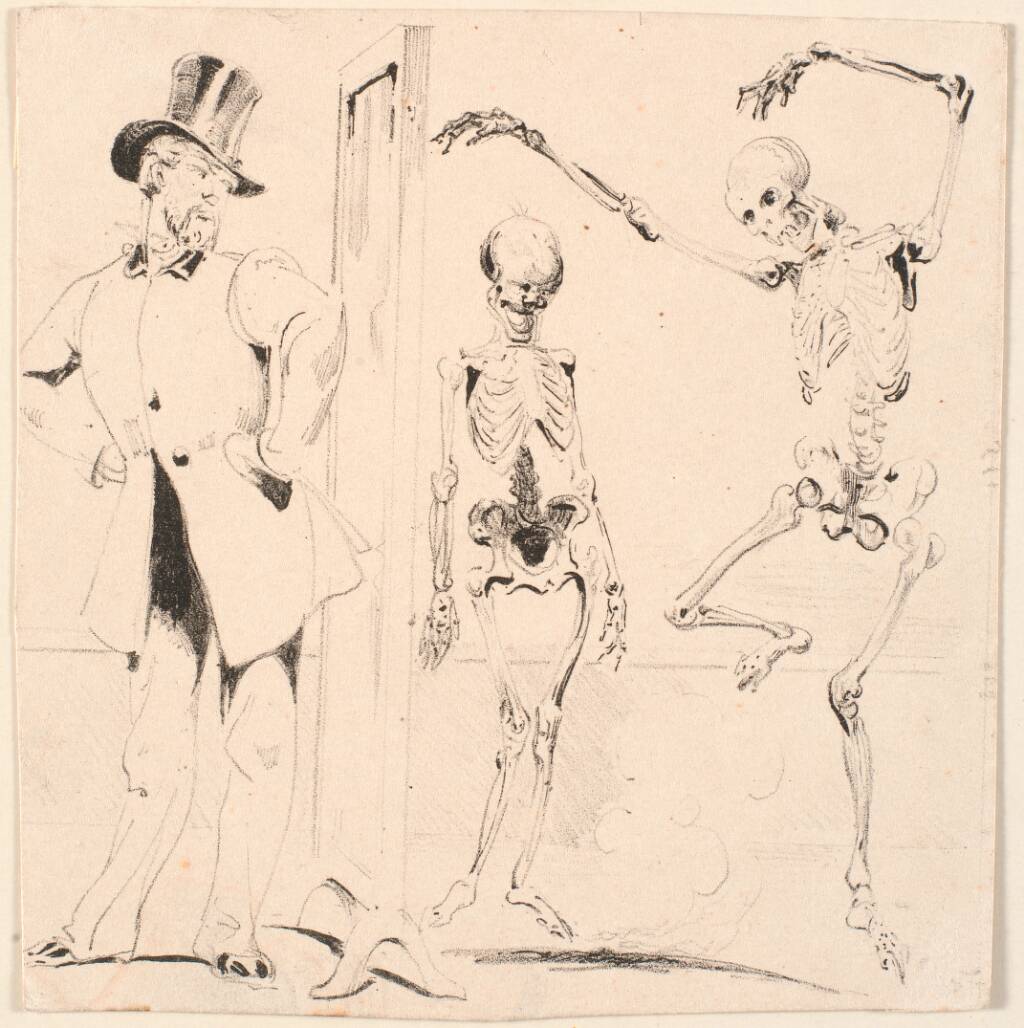
Prøveblad. Herre prøver tøj foran spejl. To benrade
✦ Read about this
This lithograph by Nicolai Habbe is a proof sheet (prøveblad), a working impression pulled to check the state of the printing before an edition was finalized. Its subject combines two unrelated motifs: a man trying on clothes before a mirror, and two skeletons — the kind of disparate studies often gathered on a single trial sheet.
Habbe worked in the mid-nineteenth century, and the print is dated broadly to the period 1847–1875. Lithography, then a relatively young technique based on the mutual repulsion of grease and water, allowed artists to draw directly on stone and reproduce their work in quantity, making it well suited to illustration and commercial printing.
The sheet is held in the collection of the SMK, the National Gallery of Denmark, in Copenhagen.
Background drawn from SMK — National Gallery of Denmark
Today's poem
Full of Life, Now.
FULL of life, now, compact, visible, I, forty years old the Eighty-third Year of The States, To one a century hence, or any number of centuries hence, To you, yet unborn, these, seeking you. When you read these, I, that was visible, am become invisible; Now it is you, compact, visible, realizing my poems, seeking me; Fancying how happy you were, if I could be with you, and become your comrade; Be it as if I were with you. (Be not too certain but I am now with you.)
Walt Whitman · Public domain
✦ Read about this
Walt Whitman (1819–1892) was an American poet, essayist, and journalist, often called the father of free verse and among the most influential poets in American and world literature. He blended transcendentalism and realism, and his 1855 collection *Leaves of Grass* was controversial in its time, described by some as obscene for its overt sensuality.
"Full of Life, Now" is written in Whitman's characteristic free verse, without regular meter or rhyme. The poem addresses a reader "yet unborn," a century or more in the future. The speaker identifies himself as forty years old in "the Eighty-third Year of The States"—dating the poem's self-description to Whitman's own life.
The poem turns on a reversal: the poet, "visible" and "full of life" as he writes, will be "invisible" by the time the words are read, while the reader will then be the living, "compact, visible" presence. Whitman imagines this future reader seeking him out, and offers his own companionship across time as comrade, insisting he may be present still.
Background drawn from PoetryDB & Wikipedia