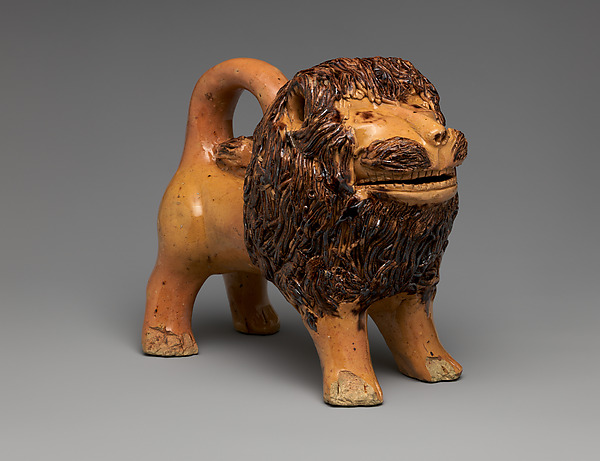
Figure of a Lion
✦ Read about this
This earthenware lion was made between 1845 and 1855 by John Bell (1800–1880), a potter who worked in Waynesboro, Pennsylvania. Bell was born in Hagerstown, Maryland, and belonged to a family of potters active in the mid-Atlantic region during the nineteenth century.
Standing 7 1/2 inches high, the figure was formed from earthenware, a locally available material typical of American folk pottery of the period. Decorative animal figures like this one were produced alongside the utilitarian wares that made up the bulk of a country potter's output.
The Metropolitan Museum of Art acquired the piece in 2016 through the purchase funds of the William Cullen Bryant Fellows, and it is held in the museum's American Wing.
Background drawn from The Met & Wikipedia
Today's poem
Summer laid her simple Hat
Summer laid her simple Hat On its boundless Shelf -- Unobserved -- a Ribbon slipt, Snatch it for yourself. Summer laid her supple Glove In its sylvan Drawer -- Wheresoe'er, or was she -- The demand of Awe?
Emily Dickinson · Public domain
✦ Read about this
Emily Dickinson (1830–1886) was an American poet who published almost nothing during her lifetime and was largely unknown as a writer while she lived; her work is now regarded as canonical. The Poetry Foundation credits her with creating "a distinctively elliptical language for expressing what was possible but not yet realized."
That ellipsis is on full display here. In two compact quatrains, the poem personifies summer as a woman putting away her hat and glove — laying the hat on a "boundless Shelf," the glove in a "sylvan Drawer." The domestic images shrink the turning of the seasons to the scale of a woman undressing and storing her things.
The poem's characteristic Dickinson features include its dashes, slant diction, and abrupt shifts of register: the offhand invitation to "Snatch" a slipped ribbon gives way to the unanswered final question about "the demand of Awe," moving from the small and casual to the unresolved and metaphysical.
Background drawn from PoetryDB & Wikipedia