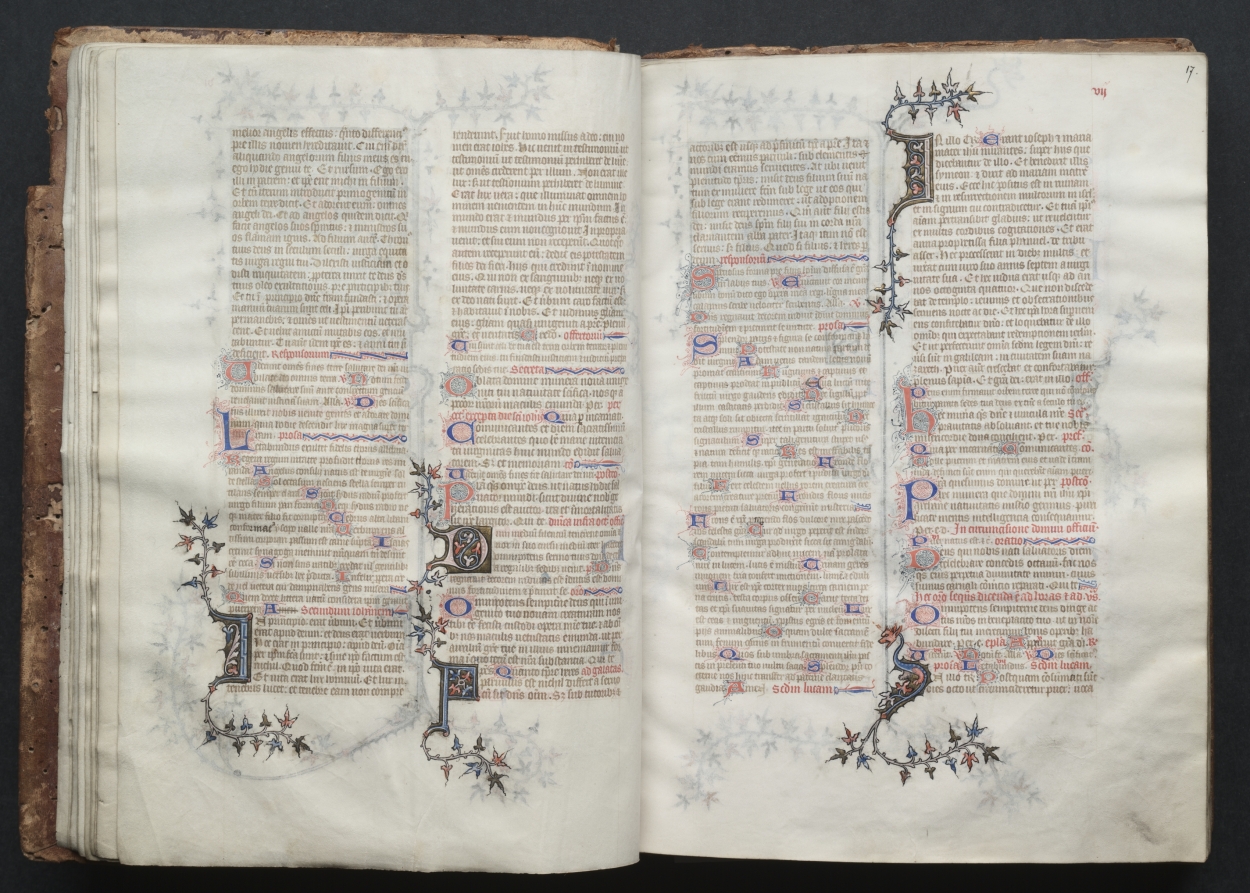
The Gotha Missal: Fol. 16v, Text
✦ Read about this
The style and quality of this manuscript's decoration is typical of deluxe Parisian books made for aristocratic or royal patrons. Most of the book's decoration appears to be the work of the Master of the Boqueteaux, an artist active at the court of King Charles V (died 1380). His style was apparently shared by a number of book illuminators working in and around Paris. It is very possible that the Gotha Missal belonged to Charles V, but is not provable because the manuscript has no royal portraits and lacks a colophon. Given the book's magnificent decoration, however, it would seem that it was produced for a Valois prince, if not for the king himself. The manuscript receives its name from the German dukes of Gotha, its later owners.
Background drawn from Cleveland Museum of Art
Today's poem
Stanzas
IN a drear-nighted December, Too happy, happy tree, Thy branches ne'er remember Their green felicity: The north cannot undo them, With a sleety whistle through them; Nor frozen thawings glue them From budding at the prime. In a drear-nighted December, Too happy, happy brook, Thy bubblings ne'er remember Apollo's summer look; But with a sweet forgetting, They stay their crystal fretting, Never, never petting About the frozen time. Ah! would 'twere so with many A gentle girl and boy! But were there ever any Writhed not at passed joy? To know the change and feel it, When there is none to heal it, Nor numbed sense to steal it, Was never said in rhyme.
John Keats · Public domain
✦ Read about this
John Keats was an English poet of the second generation of Romantic poets, alongside Byron and Shelley. His poems were in publication for less than four years before he died of tuberculosis at 25. Indifferently received in his lifetime, his reputation grew rapidly after his death, and by the end of the century he was firmly placed in the English canon, strongly influencing the Pre-Raphaelite Brotherhood.
"Stanzas" is built on a repeated contrast across its three eight-line stanzas. The first two address a tree and a brook, each described as "too happy" because neither remembers the "green felicity" or summer warmth it has lost. Frost cannot trouble them; they endure winter without regret.
The third stanza turns to human experience, wishing the same forgetting were possible for a "gentle girl and boy." People, unlike the tree and brook, feel the change and cannot heal or numb it—a grief, Keats says, that "was never said in rhyme."
Background drawn from PoetryDB & Wikipedia