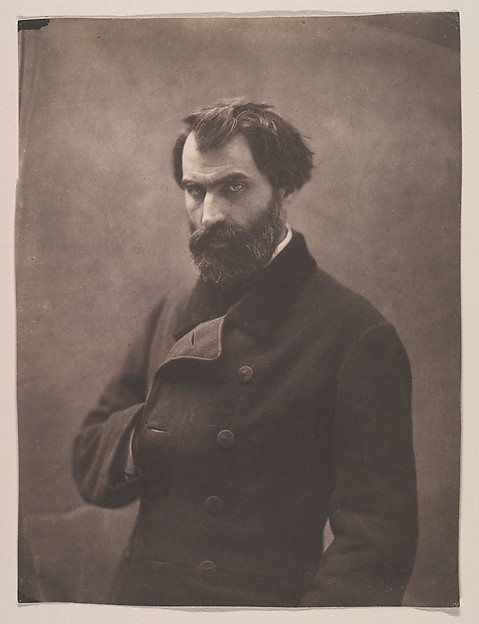
Eugène Pelletan
✦ Read about this
Nadar—the pseudonym of Gaspard-Félix Tournachon (1820–1910)—came to photography from journalism and caricature, and brought to portraiture an eye for individual character honed by drawing satirical likenesses. In 1858 he made the first aerial photographs, taken from a balloon, and his Paris studio produced portraits of many leading figures of the era.
This portrait of Eugène Pelletan was made between 1855 and 1859, near the start of Nadar's career as a portraitist. It is a salted paper print from a glass negative, a process typical of the period, measuring roughly 23.5 by 17.6 cm.
The print entered the Metropolitan Museum of Art in 1991, purchased with a gift from the Howard Gilman Foundation and the Rogers Fund.
Background drawn from The Met & Wikipedia
Today's poem
A Light exists in Spring
A Light exists in Spring Not present on the Year At any other period -- When March is scarcely here A Color stands abroad On Solitary Fields That Science cannot overtake But Human Nature feels. It waits upon the Lawn, It shows the furthest Tree Upon the furthest Slope you know It almost speaks to you. Then as Horizons step Or Noons report away Without the Formula of sound It passes and we stay -- A quality of loss Affecting our Content As Trade had suddenly encroached Upon a Sacrament.
Emily Dickinson · Public domain
✦ Read about this
Emily Dickinson published almost nothing during her lifetime and was largely unknown as a poet; the work now regarded as canonical was recognized only posthumously. The Poetry Foundation credits her with creating "a distinctively elliptical language for expressing what was possible but not yet realized."
"A Light exists in Spring" is characteristic of that ellipticism. It describes a particular quality of light peculiar to early spring — "When March is scarcely here" — a color on solitary fields that "Science cannot overtake / But Human Nature feels." The poem tracks this light as it waits on the lawn and touches the furthest tree, then passes without warning as the season advances.
Written in Dickinson's usual compact quatrains, with her signature dashes and capitalized abstractions, the poem turns a seasonal observation into a meditation on loss. The closing lines cast the light's disappearance as an intrusion, "As Trade had suddenly encroached / Upon a Sacrament."
Background drawn from PoetryDB & Wikipedia