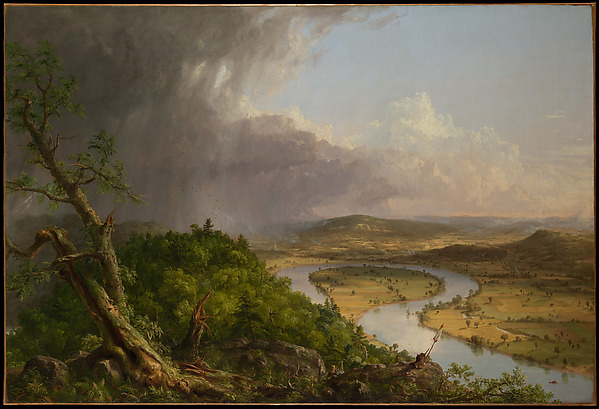
View from Mount Holyoke, Northampton, Massachusetts, after a Thunderstorm—The Oxbow
✦ Read about this
Thomas Cole painted "The Oxbow" as a deliberate large-scale statement while working on a private commission, and its composition divides the canvas between two visions of the American landscape: a dark, storm-swept wilderness on the left and, on the right, sunlit cultivated fields curving along the Connecticut River. The bend in the river near Northampton, Massachusetts, gives the work its popular name.
Cole (1801–1848), born in Lancashire, England, emigrated to the United States and became the founder of the Hudson River School, the first native movement in American landscape painting. He drew on European traditions but applied them to specifically American scenery.
The painting, an oil on canvas measuring roughly 51 by 76 inches, dates to 1836. It entered the collection of The Metropolitan Museum of Art in 1908 as a gift of Mrs. Russell Sage and is held in the American Wing.
Background drawn from The Met & Wikipedia
Today's poem
Lines Written In Early Spring
I heard a thousand blended notes, While in a grove I sate reclined, In that sweet mood when pleasant thoughts Bring sad thoughts to the mind. To her fair works did Nature link The human soul that through me ran; And much it grieved my heart to think What man has made of man. Through primrose tufts, in that green bower, The periwinkle trailed its wreaths; And 'tis my faith that every flower Enjoys the air it breathes. The birds around me hopped and played, Their thoughts I cannot measure:-- But the least motion which they made It seemed a thrill of pleasure. The budding twigs spread out their fan, To catch the breezy air; And I must think, do all I can, That there was pleasure there. If this belief from heaven be sent, If such be Nature's holy plan, Have I not reason to lament What man has made of man?
William Wordsworth · Public domain
✦ Read about this
William Wordsworth was an English Romantic poet who, together with Samuel Taylor Coleridge, helped launch the Romantic Age in English literature through their joint publication Lyrical Ballads (1798). "Lines Written in Early Spring" appeared in that volume.
The poem is built from six four-line stanzas in a simple, ballad-like measure, matching the plainness of language that characterized the Lyrical Ballads project. The speaker sits reclined in a grove, listening to birdsong and observing primroses, periwinkle, and budding twigs.
Its central movement is the turn from pleasure to sorrow: the beauty and apparent joy of the natural world prompt the speaker to lament "What man has made of man." The recurring line frames a contrast between Nature's "holy plan" and human failings, giving a meditative poem a note of social and moral disquiet.
Background drawn from PoetryDB & Wikipedia