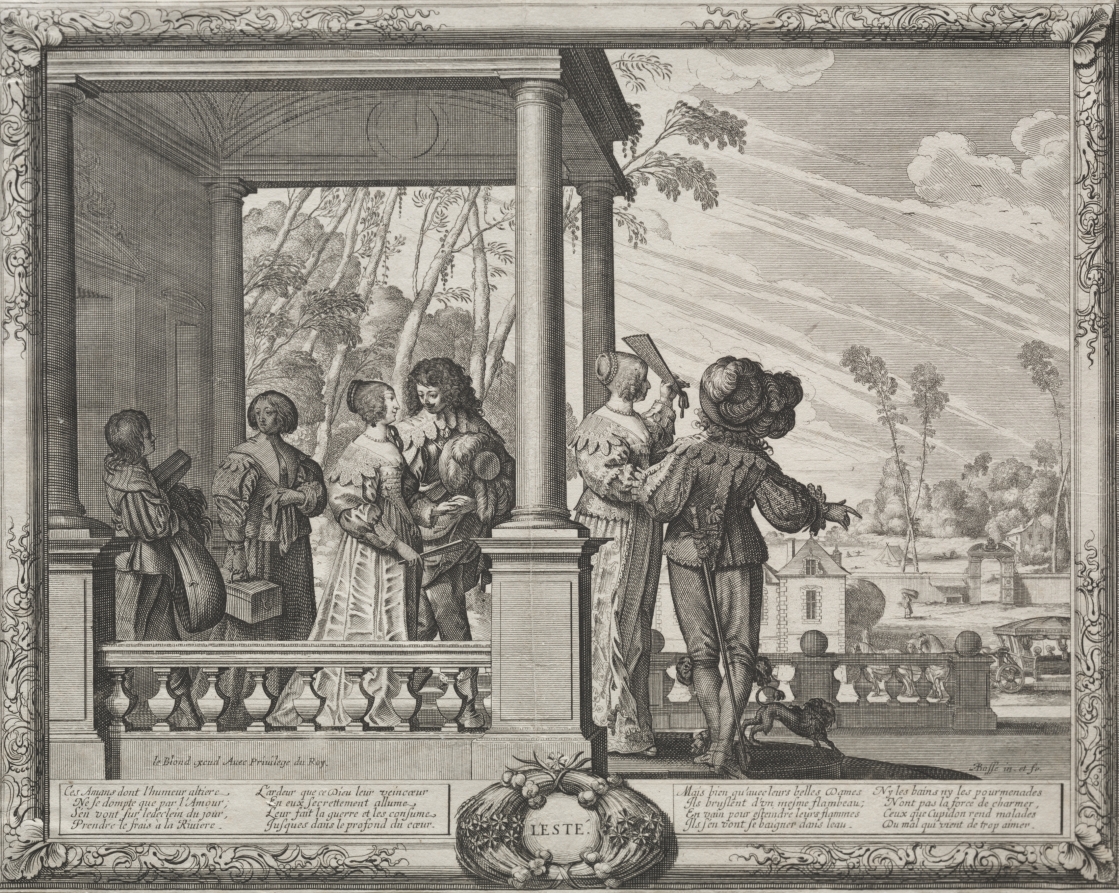
The Four Seasons: Summer
✦ Read about this
Abraham Bosse (French, 1602–1676) worked chiefly as a printmaker, favoring etching, and his prints are valued today as detailed records of French dress, interiors, and social life in the early seventeenth century. *Summer* belongs to a set depicting the four seasons, made in 1635.
The image combines engraving and etching, two intaglio techniques Bosse used together to vary line and tone. This impression entered the Cleveland Museum of Art in 1924 through the Dudley P. Allen Fund.
Background drawn from Cleveland Museum of Art & Wikipedia
Today's poem
As if the Sea should part
As if the Sea should part And show a further Sea -- And that -- a further -- and the Three But a presumption be -- Of Periods of Seas -- Unvisited of Shores -- Themselves the Verge of Seas to be -- Eternity -- is Those --
Emily Dickinson · Public domain
✦ Read about this
Emily Dickinson (1830–1886) published almost nothing during her lifetime and was largely unknown as a poet; her work reached print only after her death and is now regarded as canonical in American literature. The Poetry Foundation credits her with creating "a distinctively elliptical language for expressing what was possible but not yet realized," a description this poem bears out.
The eight lines use Dickinson's characteristic compression, dashes, and irregular capitalization. The single extended image builds by repetition: one sea parting to reveal another, and another, each an unvisited threshold to further seas.
The poem is an attempt to figure eternity through spatial metaphor. Rather than defining it, Dickinson stacks "Periods of Seas" that recede endlessly, so that any three visible seas are only a "presumption" of what lies beyond. Eternity is identified with this receding series itself—an unbounded, ungraspable extension—rather than with any final shore.
Background drawn from PoetryDB & Wikipedia