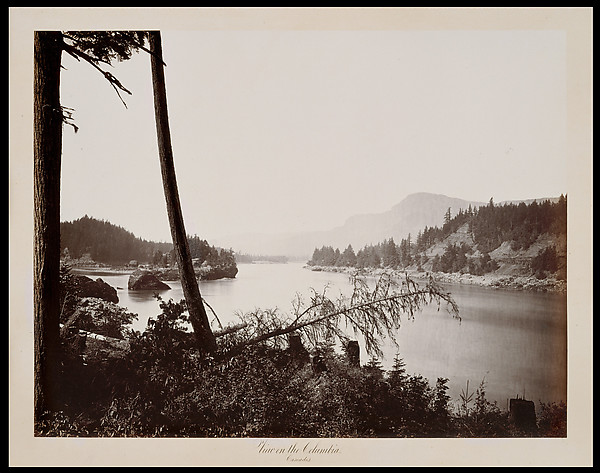
View on the Columbia, Cascades
✦ Read about this
Carleton Watkins (1829–1916) worked at a scale that few nineteenth-century photographers attempted, using large glass negatives that produced prints of exceptional detail and size. His photographs of Yosemite Valley were so persuasive that they influenced Congress to protect the area, an early instance of photography shaping American conservation policy.
This view of the Cascades of the Columbia River, made in 1867, dates from his work in the Pacific Northwest beyond his familiar California terrain. It is an albumen silver print produced from a glass negative, measuring 40 by 52.4 cm—a large format that required transporting heavy, fragile equipment into remote landscapes.
Born in New York, Watkins moved to California and took up photography there, building his reputation almost entirely on landscape subjects. The print was acquired by the Metropolitan Museum of Art in 1979.
Background drawn from The Met & Wikipedia
Today's poem
O Me! O Life!
O ME! O life!... of the questions of these recurring; Of the endless trains of the faithless—of cities fill’d with the foolish; Of myself forever reproaching myself, (for who more foolish than I, and who more faithless?) Of eyes that vainly crave the light—of the objects mean—of the struggle ever renew’d; Of the poor results of all—of the plodding and sordid crowds I see around me; Of the empty and useless years of the rest—with the rest me intertwined; The question, O me! so sad, recurring—What good amid these, O me, O life? Answer. That you are here—that life exists, and identity; That the powerful play goes on, and you will contribute a verse.
Walt Whitman · Public domain
✦ Read about this
Walt Whitman, often called the father of free verse, is considered one of the most influential poets in American and world literature. He incorporated both transcendentalism and realism in his writing, and his work was controversial in his time—his 1855 collection Leaves of Grass was described by some as obscene for its overt sensuality.
"O Me! O Life!" is built as a question and answer. The first stanza catalogues the speaker's despair: the faithlessness of crowds, cities full of the foolish, the futility of renewed struggle, and self-reproach amid "empty and useless years." It asks what good can be found in such a life.
The brief second stanza answers. The value lies simply in existence and identity: that "the powerful play goes on, and you will contribute a verse." The poem's characteristic long, accumulating lines and unrhymed structure exemplify Whitman's free verse.
Background drawn from PoetryDB & Wikipedia