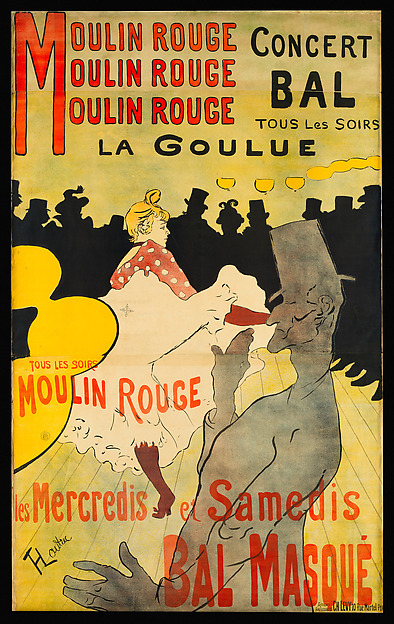
Moulin Rouge: La Goulue
✦ Read about this
This poster, Toulouse-Lautrec's first, was made in 1891 to advertise the Moulin Rouge and its star dancer La Goulue ("the Glutton"). Printed as a color lithograph on three joined sheets of wove paper, it stands nearly two meters tall—a scale meant for the walls and hoardings of Paris.
Born into an aristocratic family in Albi in 1864, Toulouse-Lautrec became a central chronicler of Belle Époque nightlife, drawing his subjects from the dance halls, cafés, and theaters of Montmartre. Here he reduced the scene to bold, flat areas of color and silhouette—techniques drawn in part from Japanese prints—with La Goulue caught mid-dance and a spectral figure in the foreground.
The lithograph in the Met's collection entered the museum in 1932 through the Harris Brisbane Dick Fund. Toulouse-Lautrec produced only a handful of posters in his short career before his death in 1901.
Background drawn from The Met & Wikipedia
Today's poem
On Journeys Through The States.
ON journeys through the States we start, (Ay, through the world—urged by these songs, Sailing henceforth to every land—to every sea;) We, willing learners of all, teachers of all, and lovers of all. We have watch’d the seasons dispensing themselves, and passing on, We have said, Why should not a man or woman do as much as the seasons, and effuse as much? We dwell a while in every city and town; We pass through Kanada, the north-east, the vast valley of the Mississippi, and the Southern States; We confer on equal terms with each of The States, We make trial of ourselves, and invite men and women to hear; We say to ourselves, Remember, fear not, be candid, promulge the body and the Soul; Dwell a while and pass on—Be copious, temperate, chaste, magnetic, And what you effuse may then return as the seasons return, And may be just as much as the seasons.
Walt Whitman · Public domain
✦ Read about this
Walt Whitman (1819–1892) was an American poet, essayist, and journalist, widely regarded as one of the most influential poets in American and world literature and often called the father of free verse. He drew on both transcendentalism and realism, and his 1855 collection Leaves of Grass drew charges of obscenity for its frank sensuality.
"On Journeys Through the States" is written in Whitman's characteristic free verse, with long, catalog-like lines and no fixed meter or rhyme. It moves geographically across the North American continent—Canada, the northeast, the Mississippi valley, the Southern States—naming places directly in Whitman's expansive manner.
The poem casts the poet and his companions as travelers who are "willing learners of all, teachers of all, and lovers of all." It takes the cycle of the seasons as a model for human giving, urging that what a person "effuses" may return as the seasons return, and calling for candor and openness of both body and soul.
Background drawn from PoetryDB & Wikipedia