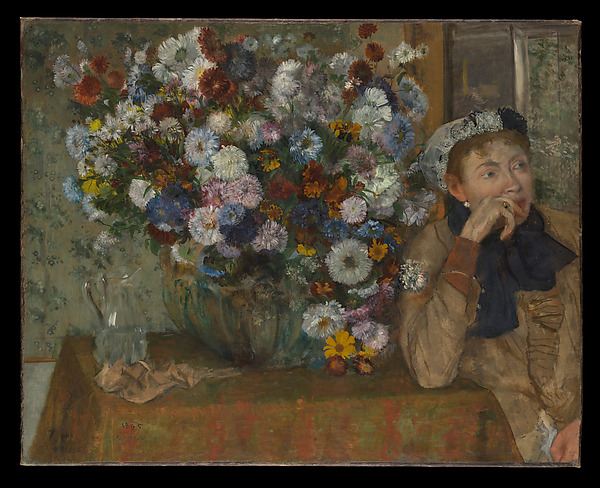
A Woman Seated beside a Vase of Flowers (Madame Paul Valpinçon?)
✦ Read about this
The bouquet dominates this 1865 canvas, while the woman—possibly Madame Paul Valpinçon, wife of a childhood friend of Degas—sits pushed to the right edge, partly cut off by the frame. The unconventional composition, with the sitter marginalized in what nominally reads as a portrait, reflects Degas's early interest in the asymmetries and croppings he would develop throughout his career.
Edgar Degas (1834–1917) worked in Paris and is best known for his pastels and oil paintings, particularly his scenes of dancers and modern life. Though associated with the Impressionists, his approach was rooted in draftsmanship and carefully constructed design rather than spontaneous plein-air technique.
The painting entered The Metropolitan Museum of Art in 1929 through the bequest of Mrs. H. O. Havemeyer, whose collection was one of the most significant sources of French art to enter an American museum.
Background drawn from The Met & Wikipedia
Today's poem
On First Looking Into Chapman's Homer
Much have I travell'd in the realms of gold, And many goodly states and kingdoms seen; Round many western islands have I been Which bards in fealty to Apollo hold. Oft of one wide expanse had I been told That deep-brow'd Homer ruled as his demesne; Yet did I never breathe its pure serene Till I heard Chapman speak out loud and bold: Then felt I like some watcher of the skies When a new planet swims into his ken; Or like stout Cortez when with eagle eyes He star'd at the Pacific--and all his men Look'd at each other with a wild surmise-- Silent, upon a peak in Darien.
John Keats · Public domain
✦ Read about this
John Keats, an English poet of the second generation of Romantics alongside Byron and Shelley, wrote poetry for less than four years before dying of tuberculosis at 25. His work was indifferently received in his lifetime, but his reputation grew rapidly after his death, and by the end of the nineteenth century he was firmly placed in the canon of English literature, influencing the Pre-Raphaelite Brotherhood.
The poem is a Petrarchan sonnet describing the experience of encountering Homer through the Elizabethan translation by George Chapman. Keats casts reading as a journey through the "realms of gold" of poetry, then reaches for two images of astonished discovery: an astronomer sighting a new planet, and explorers glimpsing the Pacific for the first time (the poem names Cortez, at a peak in Darien).
Its power lies in dramatizing intellectual revelation as physical, exploratory wonder—the shock of a familiar author suddenly opened up by a new translation.
Background drawn from PoetryDB & Wikipedia