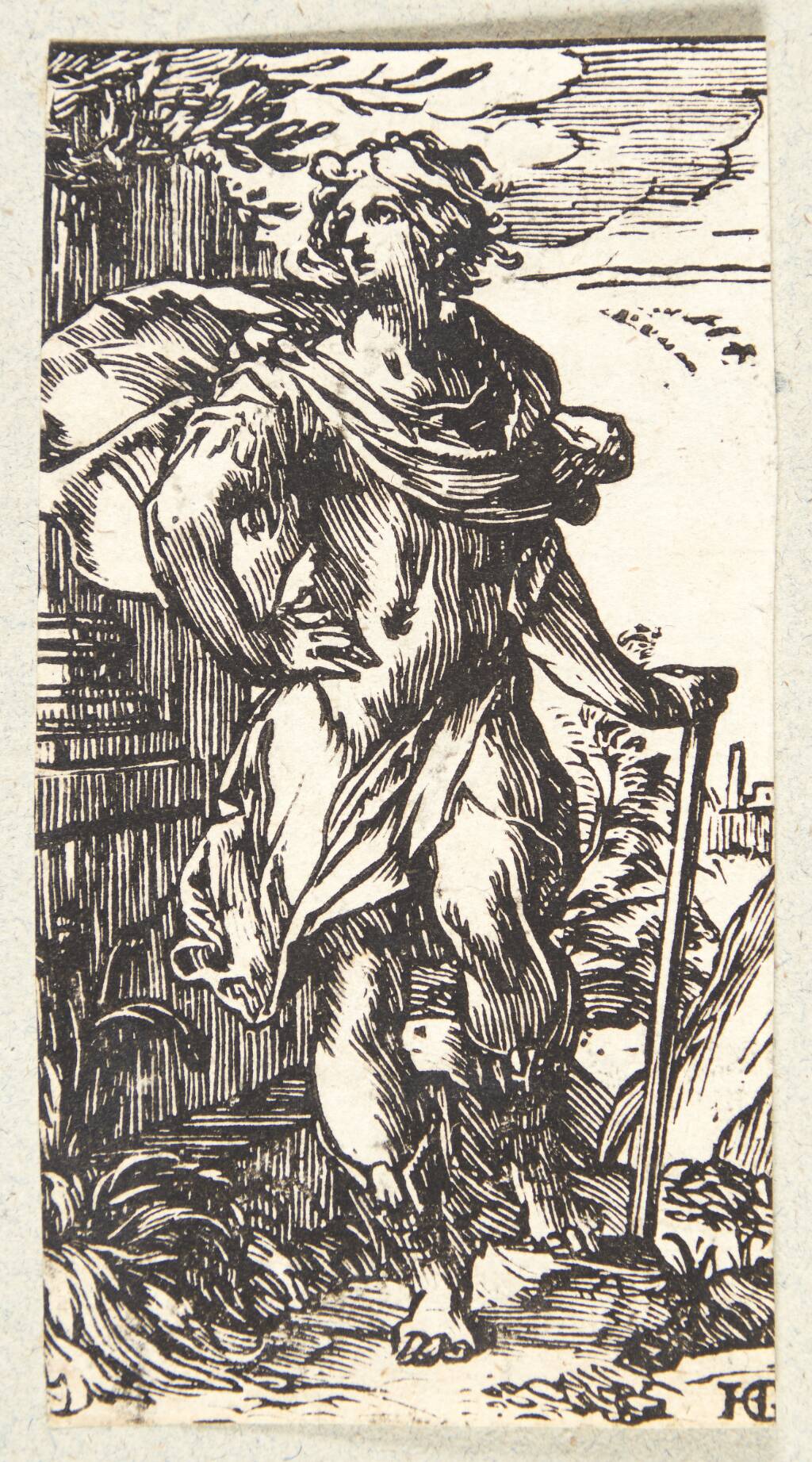
Stående ung mand med stok
✦ Read about this
Hendrick Goltzius (1558–1617) was the leading Dutch engraver of the early Baroque, celebrated for his technical virtuosity and the exuberance of his compositions. This standing young man with a staff was made as a chiaroscuro woodcut between 1596 and 1599.
The chiaroscuro woodcut is a color printing technique in which multiple blocks—typically one for the outlines and one or more for tonal areas—are printed in register to produce effects of light and shadow resembling a wash drawing. Goltzius was among the printmakers who revived and developed the method in the Northern Mannerist milieu.
Born in Germany and active in the Dutch Republic, Goltzius has been described as the last professional engraver to draw with the authority of a painter, and the last to invent many images for others to copy. He took up painting only in the latter part of his career. The sheet is held by the SMK, the National Gallery of Denmark.
Background drawn from SMK — National Gallery of Denmark & Wikipedia
Today's poem
Which is the best -- the Moon or the Crescent?
Which is the best -- the Moon or the Crescent? Neither -- said the Moon -- That is best which is not -- Achieve it -- You efface the Sheen. Not of detention is Fruition -- Shudder to attain. Transport's decomposition follows -- He is Prism born.
Emily Dickinson · Public domain
✦ Read about this
Emily Dickinson (1830–1886) — the dates are not given here; what is documented is that she published almost nothing in her lifetime and was largely unknown, yet her work is now regarded as canonical. The Poetry Foundation credits her with creating "a distinctively elliptical language for expressing what was possible but not yet realized," a description this poem bears out.
Compressed into two quatrains, the poem stages a small dialogue: asked whether the full Moon or the Crescent is best, the Moon answers "Neither," insisting that "That is best which is not." To achieve a thing, the poem argues, is to "efface the Sheen" — fulfillment destroys the anticipation that gave it value.
The second stanza pursues the same paradox: fruition is not held in "detention," and "Transport's decomposition follows" attainment. The closing image, "He is Prism born," turns desire into refracted light, valued for its unrealized possibility rather than its completion.
Background drawn from PoetryDB & Wikipedia