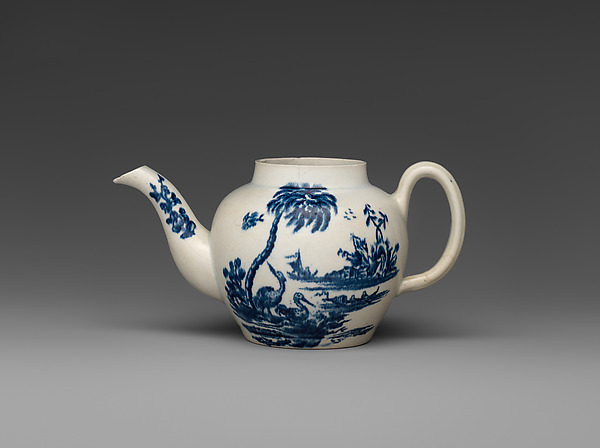
Teapot
✦ Read about this
This teapot is among the earliest known examples of porcelain made in America. It was produced by John Bartlam, a Staffordshire-trained potter who emigrated in 1763 and set up a manufactory at Cain Hoy, north of Charleston, South Carolina, later relocating to Camden.
The piece is soft-paste porcelain decorated in underglaze blue, made around 1765–69. Bartlam's ability to produce porcelain in the American colonies predates all other documented attempts, making surviving examples of his work exceptionally rare.
The Met acquired the teapot in 2018 for the American Wing, where it stands as physical evidence of early colonial ceramic manufacture and the transfer of English pottery techniques to the American South.
Background drawn from The Met & Wikipedia
Today's poem
Dust of Snow
The way a crow Shook down on me The dust of snow From a hemlock tree Has given my heart A change of mood And saved some part Of a day I had rued.
Robert Frost · 1923 · Public domain
✦ Read about this
Robert Frost was an American poet known for his realistic depictions of rural life and his command of American colloquial speech. Working mostly from settings in early twentieth-century New England, he used ordinary rural scenes to examine complex social and philosophical themes.
"Dust of Snow" is a compact example of that method. In two four-line stanzas of short, mostly two- and three-beat lines, it describes a single small event: a crow shaking snow from a hemlock tree onto the speaker. The poem's simple diction and tight rhyme scheme keep the incident concrete rather than abstract.
The subject is the effect of that minor moment. The falling snow gives the speaker's heart "a change of mood" and rescues "some part / Of a day I had rued," turning an unremarkable natural occurrence into a quiet shift from regret to relief.
Background drawn from curated & Wikipedia