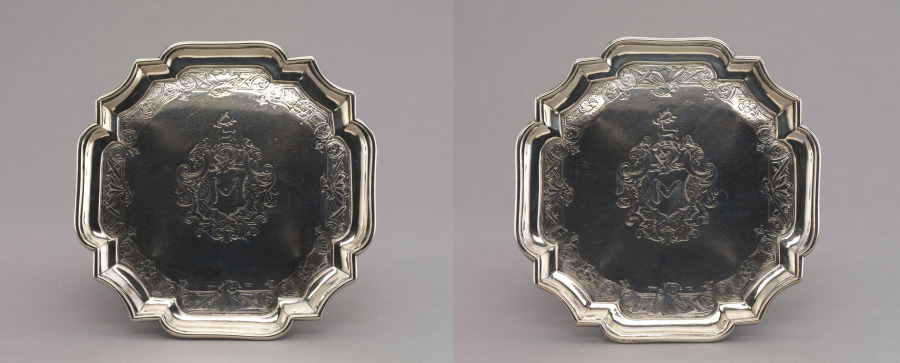
Pair of Salvers
✦ Read about this
Jacob Hurd (1702–1758) was among the leading silversmiths of colonial Boston, and the head of a silversmithing family: his sons Nathaniel and Benjamin followed the trade, as did his grandson Benjamin Hurd Jr. This pair of salvers, made in the 1740s, dates from Hurd's mature career.
The salvers are engraved with the coat of arms of the Hastings family, who first owned them. Each small tray measures about 16 centimeters square and stands roughly 3 centimeters high.
The pieces entered the Cleveland Museum of Art in 1940 as a gift from Hollis French.
Background drawn from Cleveland Museum of Art & Wikipedia
Today's poem
A Wind that rose
A Wind that rose Though not a Leaf In any Forest stirred But with itself did cold engage Beyond the Realm of Bird -- A Wind that woke a lone Delight Like Separation's Swell Restored in Arctic Confidence To the Invisible --
Emily Dickinson · Public domain
✦ Read about this
Emily Dickinson published almost nothing during her lifetime and was largely unknown as a poet until after her death, when the roughly 1,800 poems she left in manuscript began to appear in print. Her work is now considered central to American poetry. The Poetry Foundation credits her with creating "a distinctively elliptical language for expressing what was possible but not yet realized."
"A Wind that rose" is a compact example of that elliptical style. The poem describes a wind that stirs no leaf and moves "Beyond the Realm of Bird," engaging only with itself. It works through paradox and abstraction rather than concrete scene, invoking a wind that is felt inwardly rather than seen.
The short lines, slant rhyme, and heavy use of Dickinson's characteristic dashes are all present here. The poem links this invisible wind to "a lone Delight" and to "Separation's Swell," turning a natural image toward states of feeling, solitude, and the unseen.
Background drawn from PoetryDB & Wikipedia