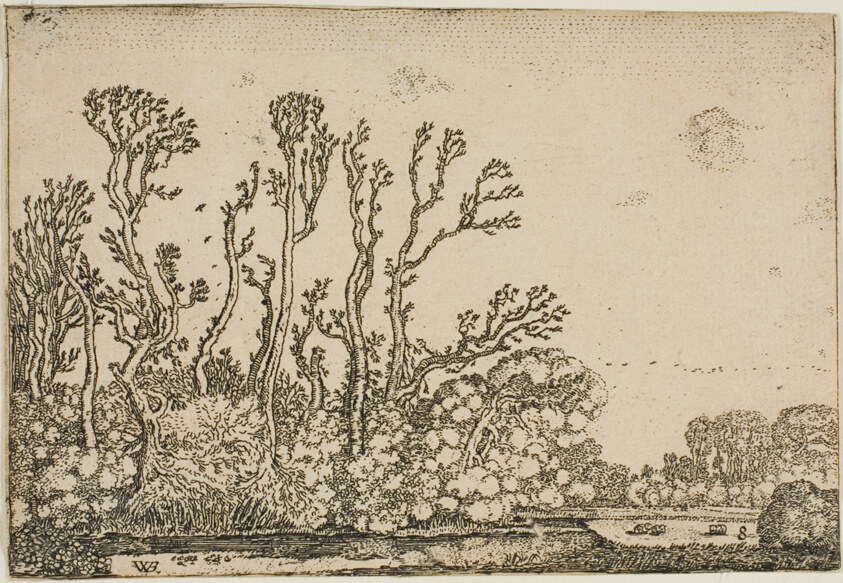
Landscape with Trees, Pond and Sheep
✦ Read about this
Willem Buytewech, whose contemporaries nicknamed him "Gheestige Willem" (roughly, "Witty" or "Ingenious Willem"), is best known as one of the early specialists in the merry company genre of Dutch Golden Age painting. This etching, made in Holland in 1621, shows a different side of his work, turning instead to a rural landscape of trees, a pond, and grazing sheep.
Buytewech worked as a painter, draughtsman, and etcher. The present print, executed in black ink on paper, belongs to his output as a printmaker rather than his figural genre scenes.
The impression at the Art Institute of Chicago came to the museum as a gift of Mrs. C. Phillip Miller.
Background drawn from Art Institute of Chicago & Wikipedia
Today's poem
Picture-Books in Winter
Summer fading, winter comes-- Frosty mornings, tingling thumbs, Window robins, winter rooks, And the picture story-books. Water now is turned to stone Nurse and I can walk upon; Still we find the flowing brooks In the picture story-books. All the pretty things put by, Wait upon the children's eye, Sheep and shepherds, trees and crooks, In the picture story-books. We may see how all things are Seas and cities, near and far, And the flying fairies' looks, In the picture story-books. How am I to sing your praise, Happy chimney-corner days, Sitting safe in nursery nooks, Reading picture story-books?
Robert Louis Stevenson · Public domain
✦ Read about this
Robert Louis Stevenson (1850–?), the Scottish novelist, essayist, poet and travel writer, is best known for the novels *Treasure Island* (1883), *Strange Case of Dr Jekyll and Mr Hyde* (1886), and *Kidnapped* (1886). Alongside this fiction he produced *A Child's Garden of Verses* (1885), a collection of poems written from a child's point of view, in which "Picture-Books in Winter" appears.
The poem is built from five quatrains, each closing on the refrain "picture story-books," which anchors its imagery of a child's indoor world during the cold months. It sets the frozen, robin-and-rook landscape of winter against the flowing brooks, sheep, shepherds, seas, cities and fairies found inside a book.
Its subject is the pleasure of reading beside the fire, "safe in nursery nooks," while frost holds the world outside. The final stanza turns to direct address, praising those "happy chimney-corner days" of childhood reading.
Background drawn from PoetryDB & Wikipedia